


![SoftPro™ Chlorine+ Carbon Whole House Water Filter to Remove PFAS, Chlorine, Chloramine & Pesticides [City Water Filters Series]](http://softprowatersystems.com/cdn/shop/files/SoftPro_Whole_House_Carbon_Filter_with_Spin_Down_Water_Filter.webp?v=1783547361&width=140)


 855-683-8488


Water Treatment · Home Guides
Water Softener for City Water: What Your Water Bill Isn't Telling You

Last updated: August 2026
Do you need a water softener for city water? Yes — your city treats water so it won't make you sick, not so your faucets stay shiny, and a water softener for city water is the thing that actually finishes the job.
Key Takeaways
- About 35.8% of U.S. cities report hard or very hard water, based on an analysis of 16,561 municipal water systems — being on a public supply is no guarantee of soft water.
- The EPA caps chlorine and chloramine in tap water at a maximum residual disinfectant level of 4.0 mg/L — legal doesn't mean tasteless or scale-free.
- More than 1 in 5 Americans drink water treated with chloramine, a disinfectant that standard carbon filters struggle to remove.
- The USGS classifies water above 10.5 grains per gallon (180 mg/L) as "very hard," and that band runs almost unbroken from the Dakotas to Texas.
- A household of four on typical city water (10-15 GPG) is usually sized to a 32,000-38,000 grain softener regenerating every 5-7 days.
- Ion-exchange softening is certified under NSF/ANSI 44; catalytic carbon chlorine/chloramine reduction falls under NSF/ANSI 42.
- A softener alone won't touch chlorine or chloramine — that's a separate job for a catalytic carbon filter.

What Is a Water Softener for City Water?
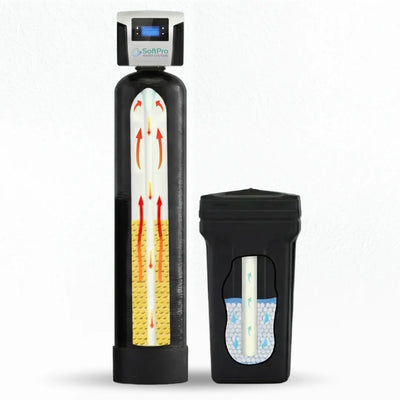
A water softener for city water is an ion-exchange system that grabs calcium and magnesium — the two minerals responsible for every crusty faucet and cloudy glass in your kitchen — and swaps them out before they ever reach your fixtures. Same core tech as a well-water softener. Different attitude required, because city water shows up already dosed with chlorine or chloramine, running on municipal pressure that doesn't quit like a tired well pump.
Here's the assumption that gets people every time: "it's city water, it's already treated, I'm good." Treated for safety and treated for hardness are two totally different jobs, and your utility only signed up for one of them.


![SoftPro™ Elite Salt Free Water Conditioner [CITY WATER]](http://softprowatersystems.com/cdn/shop/files/SoftPro_Elite_Salt_Free_Water.webp?v=1785375872&width=600)
Why Does City Water Need Softening If It's Already Treated?
Your water department's whole job is keeping you from getting sick — not keeping your shower door spot-free. Calcium and magnesium aren't a health hazard, so nobody at the treatment plant is losing sleep over them, and most facilities never run the industrial lime-softening process that would strip them out anyway. Those minerals ride the pipes straight into your house exactly as hard as they were the day they left the reservoir.
That's the part people don't expect: hard water isn't a well-water problem, it's a mineral problem, and city pipes carry minerals just fine. An analysis of 16,561 U.S. municipal systems put the national median at 99.8 mg/L (5.8 GPG) — "moderately hard" on paper — with 35.8% of cities landing flat in the hard or very hard bands. The USGS draws the very-hard line at 10.5 GPG (180 mg/L), and that band runs almost unbroken from the Dakotas down through Texas and out into the Southwest, where some utilities blow past 250 mg/L like it's nothing.
Hard city water announces itself the same way hard well water does: white crust ringing your faucets, a film on every glass that never quite comes clean, soap that refuses to lather, and a water heater quietly working overtime because scale is an insulator, not a garnish. The pipe it traveled through is the only thing that changed.
What's Actually in City Water Besides Hardness?
Hardness is only half the story your water is telling you. Utilities dose the supply with a disinfectant residual to keep it safe over miles of pipe, and that residual is either chlorine or chloramine — chlorine with a splash of ammonia stirred in. The EPA caps both at a maximum residual disinfectant level of 4.0 mg/L under 40 CFR Part 141. "Under the legal limit" and "doesn't taste like the deep end of a public pool" are, unfortunately, not the same promise.
Chloramine's the sneaky one. Utilities switched to it because it survives the trip through pipe better than chlorine and throws off fewer nasty byproducts. The catch: more than one in five Americans are now drinking it, and regular carbon shrugs it off. You need catalytic carbon, which doesn't just soak up chloramine — it breaks the molecule apart on contact.
None of that is your softener's problem to solve, and it never will be. An ion-exchange system is a one-trick machine, and the trick is hardness — it's not rated for chlorine, chloramine, PFAS, or anything else riding along in your water report. Expecting it to handle both is how city-water households end up disappointed with a perfectly good softener. If your report flags chlorine taste, chloramine, or PFOA-family chemicals, that's a separate filtration conversation entirely — our guide on how to remove chlorine and chloramine from water covers it.
How Do You Know If Your City Water Is Hard?
Your utility already told you. Somewhere in a drawer is the Consumer Confidence Report (CCR) they're legally required to mail you every year, and buried in it is your hardness number — usually in mg/L, so divide by 17.1 to get grains per gallon. Lost the mailer? Most utilities post the same report on their website.
Don't feel like hunting for a PDF? A two-dollar test strip or a titration kit gives you the same answer in under two minutes flat. For the full rundown on what that number actually means, check out our breakdown of what hard water actually is and why hardness matters and how to fix it.
| Classification | Grains Per Gallon (GPG) | mg/L (as CaCO₃) |
|---|---|---|
| Soft | 0 – 3.5 | 0 – 60 |
| Moderately hard | 3.5 – 7.0 | 60 – 120 |
| Hard | 7.0 – 10.5 | 120 – 180 |
| Very hard | Above 10.5 | Above 180 |
Source: USGS water hardness classification, as cited by municipal hardness datasets.
What Size Water Softener Do You Need for City Water?
Sizing isn't a guessing game, it's two numbers doing math. Take your household's daily water use — figure 75-100 gallons per person — and multiply it by your GPG. That's your daily grain load, and it tells you exactly how much capacity you need sitting between regenerations.
Run that math for a family of four on typical city water (10-15 GPG) and you land on a 32,000 to 38,000 grain system, cycling every 5 to 7 days. Bigger family, harder water, or you just don't want to think about it as often — go 48,000 to 64,000 grains. Undersizing is the number one softener complaint we hear, and it's always the same story: the thing regenerates nonstop, eats salt like it's free, and still can't keep up.
Salt-Based vs. Salt-Free: Which Works Better on City Water?
Both camps claim to fix hardness. Only one of them actually removes it, and that's the distinction most buying guides gloss right over.
Salt-based softening runs on ion exchange: hard water flows through a resin bed, and calcium and magnesium get physically swapped out for sodium or potassium. The minerals leave. Gone. That's also why salt-based is the only technology certified under NSF/ANSI 44 to actually claim hardness reduction — plus a bonus reduction on barium and radium-226/228 nobody asked about but gets solved anyway. Our explainer on ion-exchange softeners and how the exchange process works covers the mechanics if you want the full play-by-play.
Salt-free conditioning plays a different game entirely: template-assisted crystallization (TAC). The minerals never leave your water — they get reshaped into crystals that would rather float past your pipes than cling to them. No brine tank, no regeneration cycle, no electricity, no drain line, zero sodium added. That makes it the move for sodium-watchers, septic-system owners, or anyone in a city with softener-discharge rules on the books. Full comparison lives in salt-based vs. salt-free softening, and the mechanics are in how salt-free conditioners actually work.
| Factor | Salt-Based (Ion Exchange) | Salt-Free (TAC Conditioner) |
|---|---|---|
| Removes hardness minerals | Yes, completely | No — minerals stay, but resist scaling |
| Needs electricity | Usually (for the control valve) | No |
| Needs a drain line | Yes, for regeneration wastewater | No |
| Adds sodium/potassium | Yes, trace amounts | No |
| Regulatory certification | NSF/ANSI 44 | Performance-tested, no hardness-removal cert exists for TAC |
| Best for | Households wanting hardness eliminated outright | Sodium-sensitive households, septic systems, discharge-restricted areas |

Do You Need a Softener and a Filter for City Water?
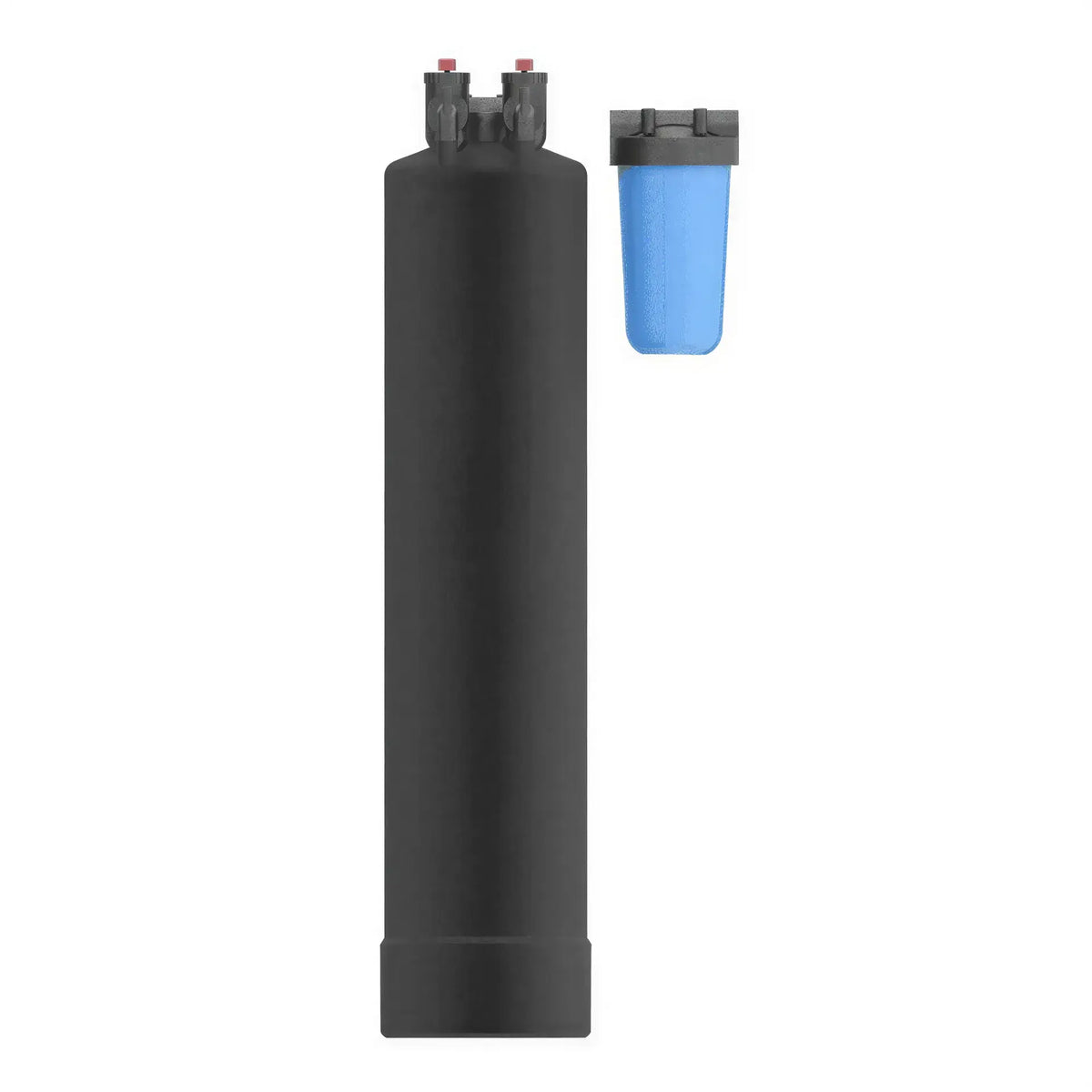
If scale, spots, and an overworked water heater are your whole complaint, a softener handles it solo. If your water report — or your own nose in the shower — is also flagging chlorine or chloramine, it's time to bring in a whole-house catalytic carbon filter. Softening and disinfectant removal are two separate chemistry problems, and no ion-exchange resin on earth does both at once, no matter what the label implies.
Catalytic carbon doesn't just trap chlorine and chloramine, it breaks them apart on contact — which is how it lands reduction rates north of 85% on chloramine specifically, a contaminant plain carbon barely dents. Pair catalytic carbon with a bone-char layer and you pick up fluoride reduction too. Run the softener first and the carbon filter second, always — it keeps minerals from fouling the carbon bed and lets both systems hit their full media life, typically 5-10 years before you touch them again.
See SoftPro's City Water Lineup
Compare salt-based, salt-free, and filter-combo systems sized for municipal water — from budget-friendly to fully automated.
Browse Water Softeners for City WaterHow Much Maintenance Does a City-Water Softener Need?
Way less than you're bracing for. Glance at the brine tank once a month, toss salt in before it hits empty, and that's the entire job on a salt-based system. Modern demand-initiated units regenerate off actual water use instead of some arbitrary clock, and upflow designs can burn up to 75% less salt and 64% less water per cycle than the old downflow style — translation: fewer trips hauling salt bags, smaller water bill from backwashing. Our salt-level guide and maintenance checklist cover the details, and how regeneration works breaks down what's happening inside that tank if you're curious.
Salt-free conditioners ask even less of you. No brine tank, no regeneration, no drain line — the maintenance list is basically "ignore it, check the media in a few years."
What Should You Look for When Choosing a City-Water Softener?
Skip the marketing copy and run down this checklist instead:
- Certification. Look for NSF/ANSI 44 on softening resin and NSF/ANSI 42 on any carbon filtration paired with it.
- Valve size. A 1-inch ported valve keeps flow rate up in homes with multiple bathrooms running at once — undersized valves are the usual cause of "my softener killed my water pressure" complaints.
- Regeneration type. Demand-initiated and upflow designs save salt and water compared to fixed-schedule downflow units.
- Grain capacity matched to your actual GPG and household size — not just whatever's on sale.
- Bypass valve for easy servicing without shutting off water to the whole house.
- Warranty length on the tank, valve, and control head separately — they don't always match.
Water Softeners for City Water: FAQ
Do I need a water softener if I already have city water?
Yes, in most cases. City water is treated for safety, not softness. Municipal treatment plants disinfect water and remove pathogens, but they don't strip out calcium and magnesium unless a utility specifically runs a lime-softening process, which most don't. Roughly a third of U.S. cities report hard or very hard water.
What grain capacity softener do I need for city water?
For a household of four on city water averaging 10 to 15 grains per gallon, a 32,000 to 38,000 grain softener typically regenerates every 5 to 7 days. Larger households or harder water push you toward 48,000 to 64,000 grains.
Does a water softener remove chlorine from city water?
No. A standard ion-exchange softener is built to swap calcium and magnesium for sodium or potassium — it isn't designed to reduce chlorine or chloramine. Removing disinfectants requires a separate catalytic carbon filter, often paired with the softener.
Is a salt-free water conditioner as good as a salt-based softener for city water?
They solve different problems. A salt-based softener removes hardness minerals entirely through ion exchange. A salt-free conditioner uses template-assisted crystallization to change the minerals' shape so they resist sticking to surfaces, but the minerals stay in the water. Choose salt-free if you want zero sodium addition, no drain line, and no electricity; choose salt-based if you want hardness eliminated completely.
Can I use potassium chloride instead of salt in a city-water softener?
Yes. Sodium chloride and potassium chloride both work in standard ion-exchange softeners. Potassium costs more but adds potassium instead of sodium to the wastewater and treated water, which some households on sodium-restricted diets prefer.
How often does a water softener need maintenance on city water?
Check the brine tank salt level about once a month and refill before it runs empty. Beyond that, a demand-initiated, upflow-regenerating softener runs its own regeneration cycle automatically based on actual water use, needing little more than an annual resin and valve check.
Will a water softener lower my city water pressure?
A correctly sized softener shouldn't cause a noticeable pressure drop. Undersized valves are the usual culprit when people complain about weak flow after installing a softener — a 1-inch ported valve is built specifically to keep flow rate up in higher-demand homes.
What's the difference between chlorine and chloramine in city water?
Chlorine is the original disinfectant municipalities use to kill pathogens; chloramine is made by adding ammonia to chlorine, which lasts longer in the pipes and produces fewer trihalomethane byproducts. The EPA caps both at a maximum residual disinfectant level of 4.0 mg/L. Chloramine is harder to filter out and typically requires catalytic carbon rather than standard carbon.
Craig "The Water Guy" Phillips
Founder of Quality Water Treatment and SoftPro Water Systems (est. 2010), with 30+ years in residential water treatment. Craig builds SoftPro's systems around transparent specs and no-pressure guidance rather than sales scripts. Connect on LinkedIn.