


![SoftPro™ Chlorine+ Carbon Whole House Water Filter to Remove PFAS, Chlorine, Chloramine & Pesticides [City Water Filters Series]](http://softprowatersystems.com/cdn/shop/files/SoftPro_Whole_House_Carbon_Filter_with_Spin_Down_Water_Filter.webp?v=1783547361&width=140)


 855-683-8488


Air Injection Oxidation vs Greensand Oxidation: How the Chemistry Differs

Air injection oxidation and greensand oxidation both remove iron, but they work very differently. AIO systems inject air into the water, using oxygen to convert dissolved iron into solid particles that get trapped and flushed out — no chemicals needed. Greensand filters rely on potassium permanganate to drive that same oxidation process, requiring ongoing chemical replenishment to stay effective. The chemistry behind each system shapes everything from maintenance demands to iron removal limits, and we'll break it all down ahead.
Key Takeaways
- AIO systems use injected oxygen from compressed air to oxidize dissolved ferrous iron, while greensand filters rely on potassium permanganate as their oxidant.
- AIO converts ferrous iron (Fe2+) into solid ferric iron (Fe3+) particles, which Katalox Light media then traps through catalytic action.
- Greensand requires periodic potassium permanganate recharging to maintain its oxidizing capacity, while AIO sustains oxidation through air injection alone.
- AIO backwashes with water only, whereas greensand demands chemical recharging with KMnO₄ to regenerate its active media.
- AIO handles iron concentrations up to 30 mg/L, while greensand's chemical oxidation maxes out around 10 mg/L.
How AIO Iron Filters Remove Iron Without Chemicals

When it comes to removing iron from your water without chemicals, AIO filters take a surprisingly elegant approach. Here's what's happening inside: a compressed air pocket oxidizes dissolved ferrous iron (Fe2+), converting it into solid ferric iron (Fe3+) particles. The Katalox Light media then traps those particles while simultaneously accelerating the oxidation process through catalytic action.
AIO filters oxidize dissolved iron into solid particles — then trap them, all without a single chemical additive.
The system also tackles dissolved manganese and hydrogen sulfide, giving you extensive treatment in a single unit.
Periodic backwashing flushes out accumulated particles, keeping performance sharp and extending media life. No potassium permanganate, no chemical regeneration cycles — just physics and catalysis working together continuously.
What makes this genuinely impressive is the capacity. We're talking up to 30 ppm of iron — handled entirely without chemical additives.
Why Greensand Filters Depend on Potassium Permanganate
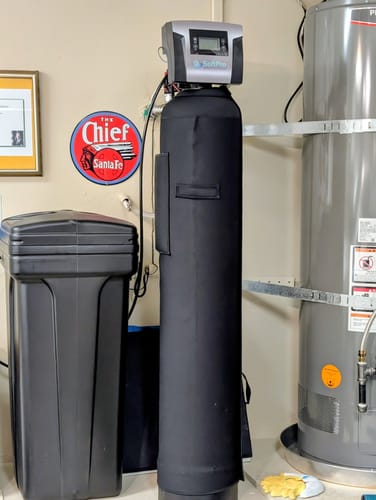
Greensand filters take a fundamentally different approach — one that hinges entirely on potassium permanganate. Unlike AIO filters that use compressed air, greensand systems depend on this chemical to continuously oxidize and precipitate dissolved iron and manganese.
That means you're managing a solution tank, monitoring chemical levels, and replenishing consistently. It's a more hands-on system compared to AIO filtration. For those who want effective iron and manganese removal with minimal chemical dependency, understanding this distinction matters enormously when choosing the right filtration approach.
Here's what makes it work: potassium permanganate doesn't just treat the water — it regenerates the greensand media itself, keeping it active and capable of adsorbing contaminants. Without regular chemical replenishment, the media loses its oxidizing capacity, and performance drops fast.
AIO vs. Greensand Iron Filter: How the Chemistry Compares
Both systems remove iron and manganese, but they take completely different chemical paths to get there. Understanding those differences helps you choose the right tool for your water chemistry.
Here's how they contrast:
- Oxidant source — AIO uses injected air (oxygen); greensand relies on potassium permanganate stored in the media
- Regeneration — AIO backwashes with water alone; greensand requires periodic KMnO₄ recharging
- Chemical dependency — AIO is self-sustaining; greensand creates an ongoing supply and handling obligation
- Operating range — AIO performs best at higher dissolved oxygen levels; greensand handles extremely high iron concentrations more aggressively
We think the chemistry tells a clear story: AIO simplifies the oxidation process, while greensand trades simplicity for raw chemical power.
Which Iron Filter Handles Your Iron Level Better?
How much iron is actually in your water? That number matters more than you might think. If your iron levels reach up to 30 mg/L, air injection oxidation handles it with ease.
Greensand filters tap out around 10 mg/L—so if your levels exceed that threshold, you're already working with the wrong system.
Here's what else we want you to examine: greensand struggles with ferric iron, the oxidized form that's already turned your fixtures orange. Air injection oxidation handles both ferrous and ferric iron effectively, giving you a more robust approach.
When iron levels are moderate to high, the chemistry simply works better with air injection. You're not fighting your system—you're allowing it to function as intended.
What Each System Actually Costs to Maintain
The real cost difference between these two systems shows up in your wallet over time—not just at installation. Let's break down what you're actually paying:
- Chemical costs: Greensand demands $50–$100 in potassium permanganate every 1–3 months; AIO needs $100–$200 annually for media replenishment.
- Water waste: Greensand backwashes consume 200–400 gallons per cycle versus AIO's 50–140 gallons.
- Time investment: Greensand requires 1–2 hours of maintenance every 1–3 months; AIO demands roughly 1 hour per year.
- Media replacement: Both systems need periodic media swaps—greensand runs $200–$400 every 4–8 years, while AIO costs $300–$500 every 5–10 years.
AIO's lower chemical dependency and reduced water consumption make it the leaner long-term investment.
Frequently Asked Questions
What Is Air Injection Oxidation?
Air Injection Oxidation uses compressed air to convert dissolved iron (Fe2+) into solid iron oxide particles (Fe3+), which we then filter out — no chemicals needed, just precise oxidation chemistry working in your system's favor.
What Do Greensand Filters Remove?
Greensand filters remove both dissolved and oxidized manganese from well water—even at levels greater than 0.05 PPM. Unlike many iron filters, they're specifically engineered to tackle manganese effectively, making them a powerful solution for cleaner water.
What Is the Best Filter Media for Iron Removal?
We recommend Katalox Light as the best filter media for iron removal. It's a catalyst and physical filter combined, handling up to 30 ppm of iron while trapping particles down to sub-micron sizes.
How Does an Air Injection Iron Filter Work?
We use a venturi nozzle to draw compressed air into your tank, creating turbulence that oxidizes dissolved iron into solid particles. Katalox Light media then catalyzes remaining iron and traps everything for easy backwashing.


