


![SoftPro™ Chlorine+ Carbon Whole House Water Filter to Remove PFAS, Chlorine, Chloramine & Pesticides [City Water Filters Series]](http://softprowatersystems.com/cdn/shop/files/SoftPro_Whole_House_Carbon_Filter_with_Spin_Down_Water_Filter.webp?v=1783547361&width=140)


 855-683-8488


Backwashable Iron Filter vs Monthly Cartridge Replacement: The ROI Case

When comparing backwashable iron filters to cartridge systems, the upfront price tag tells only half the story. Cartridge systems look affordable at $300–$950, but ongoing replacements can push your five-year total to $2,400. Backwashable systems cost more upfront yet require media replacement only every five to seven years. If your iron levels exceed 1 ppm, the long-term math strongly favors backwashable systems. Stick with us — we'll break down exactly which system wins for your specific situation.
Key Takeaways
- Backwashable systems cost $800–$5,400 upfront but save money long-term, with media replacement only every 5–7 years.
- Cartridge systems cost less initially ($300–$950) but accumulate $375–$2,400 in replacement costs over five years.
- Backwashable filters handle iron levels up to 15 ppm, making them ideal for high-contamination households.
- Cartridge systems suit small households with low iron levels under 1 ppm and modest water consumption.
- Proper sizing through comprehensive water testing is critical to maximizing savings and performance from either system.
Iron Filter Cost Breakdown: Backwashable Systems vs. Cartridge Replacements

When it comes to treating iron in your water, the upfront cost often grabs our attention first — but it's the long-term numbers that tell the real story.
Backwashable systems run $800–$5,400 upfront, while cartridge systems look friendlier at $300–$950. That gap feels significant — until you factor in time. Cartridge replacements cost $50–$200 every 6–12 months, adding up fast.
Backwashable media, by contrast, lasts 6–8 years. Stretch that out over five years, and cartridge systems total $1,050–$3,450. Backwashable systems? $1,100–$6,800 — but with dramatically less hands-on maintenance and no recurring replacement cycle eating into your budget.
The real question isn't which system costs less today. It's which system costs less over the life of your investment.
What Monthly Cartridge Costs Really Add Up to Over 5 Years of Iron Filtration
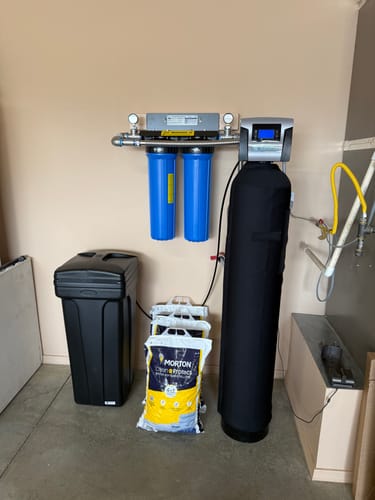
Most homeowners don't think twice about a $75–$200 cartridge swap — it feels minor in the moment. But those swaps compound fast.
| Replacement Frequency | 5-Year Total Cost |
|---|---|
| Every 6 months ($75) | $750 |
| Every 6 months ($200) | $2,000 |
| Every 12 months ($75) | $375 |
| Every 12 months ($200) | $1,000 |
That's $375–$2,400 quietly leaving your wallet — plus the repeated hassle of sourcing, swapping, and disposing of spent cartridges. We're not just talking money; we're talking disrupted water treatment every time a cartridge expires.
Contrast that with a backwashable system's media replacement: $300–$950 every 5–7 years, with continuous uninterrupted filtration in between. The math isn't close. Cartridge convenience is actually cartridge cost in disguise.
Why Backwashable Iron Filters Deliver Better Long-Term ROI for High-Iron Wells
Raw cost savings tell part of the story — but for high-iron wells, the ROI case goes deeper than cartridge math. When iron levels climb toward 15 ppm, cartridge filters don't just get expensive — they fail you. They clog fast, saturate faster, and leave you constantly reacting instead of solving the problem.
Backwashable systems handle that load without flinching. Automated backwash cycles regenerate the media continuously, keeping performance consistent without your involvement. You're looking at 6-8 years of reliable service versus an endless cycle of monthly replacements costing $500-$1,000 annually.
The upfront investment is higher — we won't pretend otherwise. But when you stack the long-term numbers, backwashable filters don't just break even. They pull ahead decisively, delivering infrastructure-grade reliability at a fraction of the lifetime cost.
When a Cartridge Iron Filter Is the Smarter Financial Choice
Backwashable systems don't win every scenario — and we'd be doing you a disservice by pretending otherwise.
For the right homeowner, cartridge filters are genuinely the smarter financial move. Here's when that's true:
- Your household is small with modest daily water consumption.
- Your iron levels are low, keeping replacement frequency manageable.
- Your budget is tight upfront, and predictable cartridge costs feel safer than a larger capital investment.
- Simplicity matters to you, and you'd rather swap a cartridge than schedule service calls.
In these cases, the lower upfront cost and straightforward maintenance of cartridge systems can actually produce a lower total cost of ownership. Knowing which system fits your situation — that's where smart financial decisions start.
The Iron Filter That Costs Less Over Time Based on Your Water Test Results
What your water test results show changes everything. If your iron, manganese, or hydrogen sulfide levels exceed 1 ppm, a backwashable system wins the long-term cost battle every time. You're looking at $300-$950 annually versus $600-$2,400 in cartridge replacements—that gap compounds considerably over five years.
But here's where most homeowners miscalculate: proper sizing matters as much as system selection. An undersized backwashable filter wastes water through excessive backwash cycles, eroding those savings. An oversized unit doesn't treat contaminants efficiently.
We always recommend getting an extensive water test before committing to either system. Your specific contaminant profile—not marketing claims—determines which investment actually pays off. The numbers tell the story clearly once you're working with real data.
Frequently Asked Questions
How Often Should an Iron Filter Backwash?
We recommend backwashing your iron filter every 4-14 days for 10-20 minutes. This routine flushes trapped particles, maintains peak performance, and extends your filter media's lifespan up to five years—maximizing your system's long-term value.
What Is the Best Filter for Removing Iron From Water?
We recommend backwashable iron filters using Katalox Light media. They're our top choice because they effectively remove high iron, manganese, and hydrogen sulfide levels while delivering lower long-term costs than cartridge-based systems.
What Are Common Problems With Iron Filters?
We've seen iron filters struggle with media fouling, bacterial growth, and contaminant breakthrough. Neglecting backwashing causes rusty stains, metallic taste, and pressure drops—ultimately forcing costly media replacements sooner than necessary.
How Often Should I Replace My Iron Filter?
For cartridge systems, we're replacing every 6-12 months. But if you've switched to a backwashable filter, you'll only need media replacement every 6-8 years—a game-changing difference in long-term maintenance.


