


![SoftPro™ Chlorine+ Carbon Whole House Water Filter to Remove PFAS, Chlorine, Chloramine & Pesticides [City Water Filters Series]](http://softprowatersystems.com/cdn/shop/files/SoftPro_Whole_House_Carbon_Filter_with_Spin_Down_Water_Filter.webp?v=1783547361&width=140)


 855-683-8488


Complete Well Water Chemistry Test Before Iron Filter Purchase: What to Test

Before buying an iron filter, we recommend testing your well water for iron levels, pH, hardness, and manganese—these four parameters form the diagnostic foundation of any smart filtration decision. Skipping even one leaves you guessing, and guessing means mismatched equipment. A certified lab test running $50–$200 gives you the decimal-level precision DIY kits simply can't match. Depending on your location, nitrates, arsenic, and bacteria testing may belong in your panel too—and there's more to unpack on all of it.
Key Takeaways
- Test iron levels first — the concentration determines which removal technology and what system capacity your well actually needs.
- Measure pH to confirm water chemistry supports effective iron oxidation and filtration before selecting any equipment.
- Test water hardness to understand the mineral load that directly affects filter performance and operational lifespan.
- Include manganese testing, as it commonly co-occurs with iron and requires its own targeted treatment approach.
- Always add bacteria testing — total coliform and E. coli contamination is invisible but poses serious health risks.
Why Well Water Testing Comes Before Any Iron Filter Purchase

Well water is rarely just water—it's a complex mixture of minerals, metals, and sometimes bacteria that varies dramatically from one property to the next. That's exactly why testing must come before purchasing any iron filter.
Well water isn't just water—it's a complex mixture that varies dramatically, making testing essential before buying any iron filter.
Without a thorough water analysis, you're essentially guessing. And guessing leads to mismatched equipment, wasted money, and water quality problems that persist long after installation.
A proper test reveals more than iron levels. It uncovers pH, hardness, manganese, sulfur, bacteria, and total dissolved solids—all of which directly affect how an iron filtration system performs. Miss any of these variables, and even a premium filter can fail.
Think of water testing as the diagnostic foundation that drives every smart decision downstream, from system selection to proper sizing.
Iron, pH, Hardness, and Manganese: The Core Well Water Tests
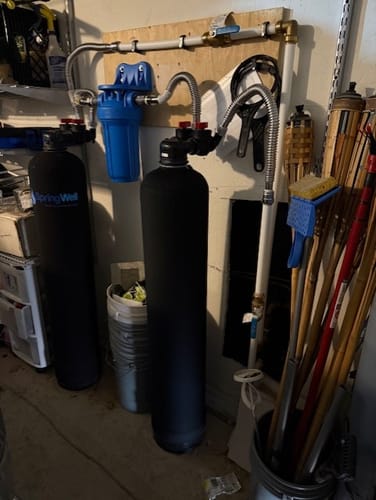
Four parameters stand at the core of every meaningful well water test: iron, pH, hardness, and manganese. Each one directly shapes which filtration system we recommend and why.
- Iron — Determines the correct removal technology and system capacity we'll need.
- pH — Confirms whether water chemistry supports effective oxidation and filtration.
- Hardness — Reveals mineral load that influences filter performance and longevity.
- Manganese — Identifies a co-contaminant requiring targeted treatment beyond standard iron removal.
Skip any one of these, and we're fundamentally guessing. These four parameters work together as a diagnostic framework, giving us the precision needed to match the right filter to our specific water chemistry.
Lab Test vs. DIY Kit: What Iron Filter Sizing Actually Requires
Once we've identified the four parameters that matter most, the next question is how we actually measure them—and that choice matters more than most people realize. DIY kits give you color-based ranges—useful for curiosity, useless for equipment sizing. Iron filter selection requires decimal-level precision, and only certified lab results deliver that.
We've seen homeowners rely on free in-home tests from treatment companies, which typically use the same basic kits. The result? Undersized equipment, recurring maintenance headaches, and water quality problems that never fully resolve.
A certified lab test runs $50 to $200+. That's a fraction of what you'll spend correcting a bad installation. When the upfront analysis is accurate, the equipment decision becomes straightforward—and the system actually works long-term.
When to Add Nitrates, Arsenic, or Bacteria to Your Well Water Panel
The core iron panel gets you far, but three contaminants—nitrates, arsenic, and bacteria—can turn a "good enough" test into a complete picture of what's actually in your water.
The core iron panel is a solid start—but nitrates, arsenic, and bacteria complete the picture.
- Nitrates – Add this if your well sits near agricultural land, septic systems, or fertilizer application zones.
- Arsenic – Test if you're in a region with natural arsenic deposits or near mining activity.
- Bacteria (total coliform + E. coli) – Always include this; microbial contamination doesn't announce itself.
- Radon – Add if your region shows elevated groundwater radon levels.
We'd also recommend tannin and copper testing to catch organic matter or plumbing-sourced contamination your iron panel won't flag.
How to Pull a Water Sample That Gives You Accurate Results
Pulling a water sample sounds simple—and it is—but a few missteps can send your results sideways before the lab ever touches it. Start with a clean, sterile container—no substitutions.
Let cold water run for two to three minutes first to flush the pipes completely; stagnant water sitting in your lines won't represent what your well actually produces. Use cold water only, since hot water chemistry differs.
Never touch the inside of the container—your skin introduces bacteria that corrupt bacterial counts instantly. Label everything clearly and get the sample to the lab within 24 to 30 hours for accurate bacteria testing. Delay longer, and microbial activity shifts, skewing your results.
Precision here protects every decision you'll make downstream about filtration.
Frequently Asked Questions
How Can I Test My Well Water for Iron Content?
We recommend starting with a basic iron test kit from your hardware store for quick results, then sending a sample to a certified lab to measure exact iron concentration in parts per million.
How Do I Know if My Well Water Is High in Iron?
You'll know your well water's high in iron if you notice rusty-colored water, metallic taste, or reddish-brown stains on fixtures and laundry. Lab testing confirming levels above 0.3 ppm makes it official.
What Tests Should Be Done on Well Water?
We recommend testing for iron, pH, hardness, manganese, sulfur, bacteria, and total dissolved solids. Depending on your situation, you'll also want tests for nitrates, lead, arsenic, radon, tannins, copper, and volatile organic compounds.
How Can I Test for Iron in a Water Sample?
We can test iron in a water sample two ways: send it to a certified lab using EPA-approved methods for accuracy, or use a home test kit for a quick but less precise screening.


