


![SoftPro™ Chlorine+ Carbon Whole House Water Filter to Remove PFAS, Chlorine, Chloramine & Pesticides [City Water Filters Series]](http://softprowatersystems.com/cdn/shop/files/SoftPro_Whole_House_Carbon_Filter_with_Spin_Down_Water_Filter.webp?v=1783547361&width=140)


 855-683-8488


Diagnosing Whether Your Iron Problem Is a Well Problem or a Plumbing Problem

When your water runs orange or your toilet tank looks like a rust museum, the first question we need to ask isn't how to fix it — it's where it's coming from. Well iron and pipe iron look almost identical but demand completely different solutions. Install the wrong treatment and you've wasted serious money while the stains keep spreading. Learning to tell them apart is the entire strategy, and we've mapped out exactly how to do it.
Key Takeaways
- Identifying whether iron originates from your well or your pipes is the essential first step before choosing any treatment solution.
- Well-sourced iron causes widespread staining throughout the entire house, often with reddish-brown slime visible inside toilet tanks.
- Pipe-sourced iron typically affects only certain faucets, clears after running water briefly, and worsens significantly in hot water lines.
- Simple diagnostic steps include collecting water samples, observing discoloration patterns, and checking for seasonal or post-rain changes.
- Confirm your diagnosis with a certified lab test to ensure you select the correct and cost-effective treatment method.
Your Well or Your Pipes: Two Iron Problems That Need Different Fixes

When iron problems suddenly show up out of nowhere, the first question we need to ask isn't "how do we fix it?" — it's "where is it actually coming from?" The answer determines everything, because iron sneaking in through aging pipes is a completely different beast than iron-saturated well water flooding your entire supply.
These are two distinct problems demanding two distinct solutions. A plumbing issue might only need a water softener. A well problem often requires a heavy-duty oxidizing filter. Install the wrong one, and you've wasted serious money while the stains keep spreading.
That's why diagnosing the source first isn't optional — it's the entire strategy. Reviewing your water quality history and testing current iron levels points us straight toward the real culprit.
5 Symptoms That Point to the Well, Not the Pipes
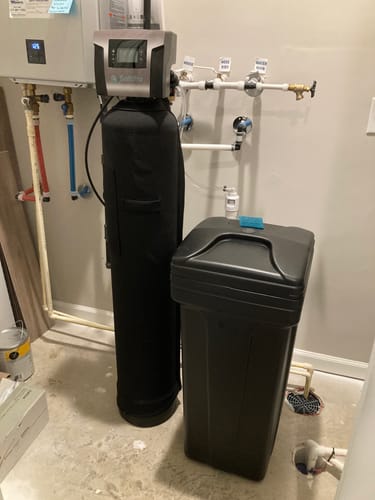
Once we've ruled out the pipes, the well becomes our prime suspect — and it has a few telltale ways of announcing itself. Watch for water that starts clear but turns red, brown, or yellow after sitting — that's dissolved iron traveling straight from the source.
Spot reddish-brown slime or an oily sheen inside your toilet tank? That's iron-loving bacteria thriving in your well. When staining hits every fixture and appliance throughout the house simultaneously, that's not a localized pipe failure — that's a systemic supply problem. Same logic applies to widespread appliance clogging.
And if the shift happened suddenly — clear water one day, rust-colored the next — the well changed, not the plumbing. These patterns tell a coherent story once you know how to read them.
5 Symptoms That Point to the Pipes, Not the Well
The well tells one story, but your pipes tell another — and knowing the difference saves you from chasing the wrong fix.
If only certain faucets show iron staining while others run clean, your plumbing is the culprit, not your well. Notice hot water staining far worse than cold? Suspect your water heater or hot water pipes. Watch for reddish-brown water that clears after running a few minutes — that's iron collecting inside your pipes between uses, not coming from your source.
Two clues carry serious diagnostic weight: inconsistent discoloration between taps and a sudden onset of iron problems after years of clear water. When the well hasn't changed but your water has, look inward — your pipes are confessing something worth hearing.
The Diagnostic Test That Identifies Your Iron Source
Pinpointing your iron source doesn't require guesswork — it requires a simple sequence of observations that each rule something in or out. Start by letting a glass of water sit undisturbed. Clear water that slowly turns red signals dissolved iron; water that's already red suggests suspended iron.
Next, check whether the staining appears in hot water only — that points to your pipes. If cold water's affected too, your well becomes the suspect.
Then peek inside your toilet tank. Red-brown slime or an oily sheen means iron bacteria, a well-originated problem. Notice any seasonal patterns or post-rain changes? That's another well indicator.
Finally, confirm everything with a certified lab test — it reveals exact iron concentration and chemical form, giving you the precision to choose the right treatment.
How to Treat Iron in Well Water Once You've Found the Source
Now that we've tracked down where our iron is coming from, let's talk about what we actually do about it — because the fix depends entirely on the source. Ferrous iron responds well to an AIO filter; ferric iron needs a backwashing filter with specialized media. Bacterial iron requires a two-step approach — shock chlorination first, then filtration. Colloidal iron, that stubborn suspended variety, calls for a high-quality sediment or multimedia filter.
Here's something most people overlook: regardless of which system we install, a sediment filter always goes first. It protects everything downstream. And once our system's running, regular water testing keeps it honest — because a treatment system we've stopped monitoring is one that's quietly failing us.
Frequently Asked Questions
What Are the Signs That My Body Isn't Absorbing Iron?
If your body's not absorbing iron well, you'll notice fatigue, pale skin, brittle nails, frequent infections, slow wound healing, difficulty concentrating, shortness of breath during exercise, or restless legs—all red flags we shouldn't ignore.
How Do I Know if I Have Iron Bacteria in My Well?
We'll know iron bacteria's invaded our well when we spot reddish-brown slime, smell rotten eggs, notice reduced water flow, or see biofilm on fixtures. Lab testing confirms it definitively.
What Is the Best Water Treatment for High Iron Levels?
The best treatment depends on your iron type. For ferrous iron under 5 mg/L, we'll use a water softener. Over 5 mg/L or ferric iron? An AIO filter's our go-to solution.
Will Shocking a Well Get Rid of Iron?
Shocking a well won't permanently rid you of iron. It can temporarily knock back iron bacteria, but if iron's seeping in from surrounding geology, we're just masking the real problem.


