


![SoftPro™ Chlorine+ Carbon Whole House Water Filter to Remove PFAS, Chlorine, Chloramine & Pesticides [City Water Filters Series]](http://softprowatersystems.com/cdn/shop/files/SoftPro_Whole_House_Carbon_Filter_with_Spin_Down_Water_Filter.webp?v=1783547361&width=140)


 855-683-8488


High vs Low Iron Water Test Results: How Treatment Complexity Changes

Your iron test results directly shape how complex your treatment needs to be. Below 0.3 ppm, a simple water softener handles the job. From 0.3–3 ppm, you'll need an oxidizing filter. Push past 3 ppm, and oxidation systems become necessary. Exceed 10 ppm, and you're looking at multi-stage chemical treatment. The form of iron—ferrous or ferric—matters just as much as the level, and understanding both reveals the right solution for your water.
Key Takeaways
- Iron below 0.3 mg/L needs no treatment, while levels up to 3 ppm require only basic filtration or a water softener.
- Ferric iron is easier to treat with simple filtration, while dissolved ferrous iron requires oxidation before filtration.
- Iron levels between 3–10 ppm demand oxidation systems or aeration to convert ferrous iron into filterable particles.
- Levels from 10–30 ppm require chemical oxidation plus heavy-duty filtration, significantly increasing treatment complexity and cost.
- Iron exceeding 30 ppm necessitates multi-stage treatment, including chemical oxidation, sedimentation, and water softening for effective removal.
What Do Your Iron Test Results Actually Mean?

When you get your water test results back, those numbers mean more than just a passing grade or a red flag — they tell you exactly what kind of treatment your water needs. We break iron levels into five distinct ranges, each pointing toward a specific solution.
Your water test results don't just flag a problem — they point directly to the solution.
Below 0.3 mg/L? You're in the clear. From 0.3–3 mg/L, you'll notice taste and staining issues that basic filtration resolves.
Push into 3–10 mg/L territory, and oxidation systems enter the picture. At 10–30 mg/L, chemical oxidation becomes necessary before filtration can even work effectively. Beyond 30 mg/L — rare, but it happens — you're looking at multi-stage treatment, including water softening.
Each threshold isn't arbitrary; it reflects how iron's chemistry fundamentally changes your removal strategy.
Ferrous vs. Ferric Iron: Does the Form Change Your Treatment?
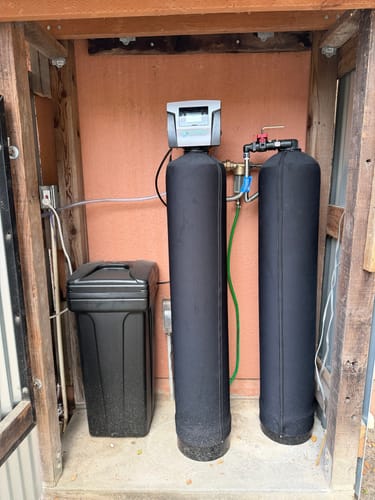
The form iron takes in your water isn't a minor detail — it's the deciding factor in how hard your treatment system has to work. Ferrous iron stays dissolved and invisible; ferric iron already precipitates as reddish-brown particles. That difference dictates everything downstream.
| Iron Type | Appearance | Treatment Needed |
|---|---|---|
| Ferric (Fe3+) | Reddish-brown particles | Simple filtration |
| Ferrous (Fe2+) | Clear, dissolved | Oxidation + filtration |
| Mixed | Varies | Multi-stage process |
| High ferrous ratio | Clear water | Complex oxidation system |
| Low ferrous ratio | Visible particles | Streamlined filtration |
We always recommend testing both ferrous and total iron levels. Knowing your ratio tells us whether we're dealing with a straightforward filter installation or a more demanding oxidation-first approach.
How to Treat Low Iron Levels Under 0.3 Ppm
If your iron levels test below 0.3 ppm, you're in luck — a basic water softener can handle the job. These systems use ion exchange to capture dissolved ferrous iron and flush it out during regeneration cycles. It's a straightforward, cost-effective solution that doesn't require advanced filtration equipment.
At this level, we're mostly dealing with aesthetic concerns — staining, discoloration, and that metallic taste that makes drinking water unpleasant. There's no significant health risk, but those annoyances add up fast.
Worth noting: softeners remain effective up to around 2-3 ppm of ferrous iron. So if your test results land under 0.3 ppm, you've got a manageable problem with a well-established fix already on the market.
Why High Iron in Well Water Needs More Than a Basic Filter
Once iron levels climb past 3 ppm, a basic water softener simply can't keep up. At this concentration, we're dealing with chemistry that demands a more engineered response.
Ferrous iron must first be oxidized into ferric iron before filtration can remove it. That means adding air injection systems or chemical feed pumps to your treatment train.
| Challenge | Required Solution |
|---|---|
| Ferrous (clear) iron | Oxidation system |
| Iron bacteria biofilm | Pre-treatment disinfection |
| High particulate iron | Advanced filtration |
| Co-occurring manganese | Additional treatment stage |
We also can't ignore iron bacteria—that slime clogs standard filters fast. And if manganese co-occurs, which it often does, you'll need yet another treatment step. Customized system design isn't optional here; it's essential.
Match Your Iron Level and Iron Type to the Right Filter
Matching your iron level to the right treatment system starts with two questions: how much iron is in your water, and what form is it taking? Ferrous iron stays dissolved and clear, while ferric iron already appears as rust particles. That distinction matters enormously.
Not all iron behaves the same. Knowing how much you have—and what form it takes—determines everything.
Under 0.3 ppm of ferrous iron? A water softener handles it. Between 0.3 and 3 ppm? You'll need an oxidizing filter to convert dissolved iron into filterable particles.
Push into the 3–10 ppm range, and aeration or chemical treatment enters the picture. Exceed 10 ppm, and we're talking multi-stage systems involving chemical oxidation, sedimentation, and heavy-duty filtration.
Test first, then treat. Skipping that step means gambling on equipment that may completely miss the problem.
Frequently Asked Questions
How to Treat Water With High Iron Content?
For iron above 0.3 mg/L, we'll need chemical oxidation and filtration systems. If levels hit 5-10 mg/L, aeration systems work best, converting ferrous iron into filterable ferric form efficiently.
Which Is Worse, Low Ferritin or Low Iron?
Low ferritin's worse. It signals depleted total iron stores throughout your body, causing fatigue, hair loss, and cognitive issues. Low iron alone typically requires simple dietary fixes, while low ferritin demands more intensive treatment strategies.
What Does It Mean if I Have Low Iron Saturation and High Iron Binding Capacity?
If you've got low iron saturation and high iron binding capacity, you're likely dealing with iron deficiency anemia. Your body's desperately producing more transport proteins, trying to capture every bit of available iron it can find.
What Are the Effects of High Iron Levels in Water?
High iron levels in your water can cause fixture staining, metallic tastes, clogged plumbing, and slimy bacterial biofilms. We're looking at levels above 0.3 mg/L triggering these problems, with anything over 10 mg/L demanding complex chemical treatment.


