


![SoftPro™ Chlorine+ Carbon Whole House Water Filter to Remove PFAS, Chlorine, Chloramine & Pesticides [City Water Filters Series]](http://softprowatersystems.com/cdn/shop/files/SoftPro_Whole_House_Carbon_Filter_with_Spin_Down_Water_Filter.webp?v=1783547361&width=140)


 855-683-8488


How to Assess Iron Damage to Plumbing Before Installing an Iron Filter

Before installing an iron filter, we need to assess what iron has already done to your plumbing. Look for reddish-brown stains on fixtures, clogs in faucets and appliances, and discolored water with a metallic taste. Check your water heater for rapid anode rod corrosion. Then get a water test to identify iron type, concentration, and pH levels. Understanding the full picture helps us match the right filter to the actual damage we're dealing with.
Key Takeaways
- Look for reddish-brown stains on sinks, toilets, and fixtures as early indicators of iron damage in your plumbing system.
- Check showerheads, faucets, and appliances for clogs caused by iron buildup restricting water flow and pressure.
- Inspect your water heater's anode rod for rapid corrosion, which signals elevated iron levels throughout the system.
- Conduct a professional water test to identify ferrous or ferric iron, manganese, pH levels, and contamination severity.
- Repair compromised plumbing before installing a filter, as existing damage reduces filtration efficiency and causes premature system failure.
The Warning Signs of Iron Damage in Your Plumbing

Before installing an iron filter, we need to take stock of the damage iron may have already done to your plumbing. Knowing what to look for helps you make smarter decisions about filtration and repairs.
Start by checking your fixtures, sinks, and toilets for reddish-brown stains—iron's calling card. Inspect your showerheads, faucets, and appliances for clogs caused by iron buildup. You'll also want to examine your water heater's anode rods; rapid corrosion signals an iron-rich supply working against your system.
Don't overlook your laundry. Dingy, yellowish-brown loads aren't a detergent problem—they're iron leaving its mark on your fabrics. Each of these warning signs tells you exactly how aggressively iron has infiltrated your plumbing, guiding your next steps.
What Iron Damage Actually Looks Like in Pipes, Fixtures, and Appliances
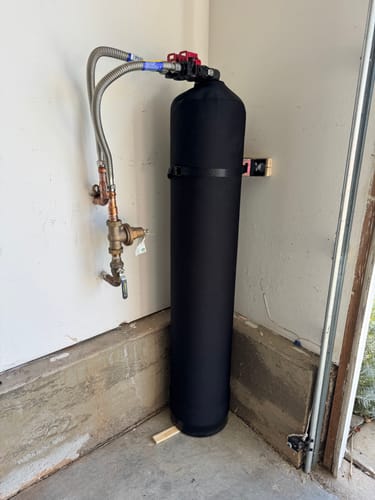
Iron damage doesn't just show up overnight—it builds up gradually until the evidence is impossible to ignore. Knowing what to look for helps us accurately gauge severity before selecting a filtration solution.
Iron damage builds gradually—and by the time it's impossible to ignore, it's already taken a toll.
Pipes: Restricted flow and pressure drops signal internal buildup narrowing the passageway
Fixtures: Rust-colored stains on sinks, tubs, and toilets indicate prolonged iron-laden water contact
Appliances: Washing machines develop clogged components, while water heaters lose efficiency and fail prematurely
We can also detect iron contamination through discolored water and a metallic taste—both reliable indicators of elevated iron levels. Each symptom tells us something specific about contamination severity, helping us make a smarter, more targeted filtration decision.
What Your Water Test Reveals About Your Iron Problem
Once we comprehend iron damage is present, the next question becomes *how bad is it really*—and that's exactly what a proper water test answers. Testing identifies whether you're dealing with ferrous (dissolved) iron, ferric (particulate) iron, or both—because each type demands a different treatment approach. When levels exceed 5 mg/L, you're looking at more aggressive filtration solutions, not just a basic inline filter.
But iron rarely travels alone. Testing for manganese, sulfur, and pH gives you the complete picture, revealing interactions that affect which filter media will actually perform. This exhaustive data isn't just informative—it's the blueprint for designing a whole-home system precisely matched to your water's chemistry. Without it, you're guessing. With it, you're solving.
Does Your Plumbing Need Repairs Before the Filter Goes In?
Your water test hands you a roadmap, but that roadmap might reveal more than just iron levels—it might expose years of damage already baked into your pipes. Installing a new iron filter over compromised plumbing is like putting new tires on a bent axle. We recommend having a plumber inspect your system first, especially if you've got older galvanized or cast iron pipes.
Fixing major plumbing issues beforehand isn't optional—it's what guarantees your new system performs at its full potential.
Here's what ignoring existing damage actually costs you:
- Persistent clogs that choke flow before water even reaches the filter
- Low water pressure that undermines the filter's removal efficiency
- Premature filter failure caused by iron buildup the system can't overcome
Which Iron Filter Is Right for Your Level of Plumbing Damage
Now that you understand what's at stake with existing plumbing damage, matching the right iron filter to your specific situation becomes the logical next step. Your iron levels and existing corrosion dictate everything about system selection.
| Iron Level / Damage Severity | Recommended Filter Approach |
|---|---|
| Light staining, minimal corrosion | Basic oxidizing iron filter |
| Moderate iron, some pipe damage | Whole-home filtration system |
| High concentration (10+ mg/L) | Multi-stage oxidation technology |
Professional water testing reveals exactly where you fall on that spectrum. We'd strongly encourage consulting a local water treatment expert—they'll size and configure a system that addresses your specific water chemistry and plumbing condition, ensuring you're not under-filtering and inviting continued damage.
Frequently Asked Questions
Should an Iron Filter Be Installed Before or After a Water Softener?
We recommend installing your iron filter before the water softener. This protects your softener's resin bed from iron fouling, extending its lifespan and keeping your entire system performing at peak efficiency.
What Are the Symptoms of Too Much Iron in Well Water?
We'll notice reddish-brown stains on sinks, toilets, and laundry, a metallic taste in water, discolored beverages, reduced water pressure from pipe buildup, and clogged showerheads or faucet aerators—all telltale signs of excessive iron.
How Much Does It Cost to Have an Iron Filter Installed?
Installing an iron filter typically costs $1,900–$2,750 for a mid-range system. Budget options start at $300, while high-capacity whole-home systems can reach $12,000, depending on your home's size, plumbing complexity, and water quality demands.
How to Install an Iron Filter?
To install an iron filter, we'll shut off the main water supply, cut into the supply line, install bypass valves, mount the filter tank, connect inlet/outlet pipes, add the media, then restore water flow carefully.


