


![SoftPro™ Chlorine+ Carbon Whole House Water Filter to Remove PFAS, Chlorine, Chloramine & Pesticides [City Water Filters Series]](http://softprowatersystems.com/cdn/shop/files/SoftPro_Whole_House_Carbon_Filter_with_Spin_Down_Water_Filter.webp?v=1783547361&width=140)


 855-683-8488


How to Interpret a Full Well Water Chemistry Panel for Iron Treatment

When interpreting a full well water chemistry panel for iron treatment, we look at several critical markers: iron type and concentration, pH, hardness, manganese, and bacterial presence. Each result directly points to a specific treatment system — and getting it wrong means installing equipment that fails fast. Ferrous, ferric, and bacterial iron all demand different solutions. pH and hardness determine which filter media actually lasts. Stick with us and we'll break down exactly what every number means.
Key Takeaways
- Ferrous iron above 5 mg/L requires an air injection oxidation filter, while levels below 5 mg/L can use a water softener.
- Ferric iron between 3–15 mg/L needs a backwashing filter with specialized media designed for oxidized iron particles.
- pH below 6.8 favors pyrolox or greensand media, while pH above 7.0 enables catalytic media like BIRM.
- Manganese co-occurring with iron demands oxidizing media such as catalytic carbon or greensand for effective long-term performance.
- Iron bacteria requires shock chlorination before filtration, as biofilms will clog any standard iron treatment system.
What Does a Well Water Chemistry Panel Actually Test For?

When you send a water sample to a certified lab, you're getting back more than just an iron reading — a full well water chemistry panel tests for a wide range of parameters including pH, hardness, manganese, sulfur, bacteria, and total dissolved solids. Each parameter tells a distinct story about your water's character.
Depending on your situation, the lab may also test for nitrates, lead, arsenic, radon, tannins, copper, and volatile organic compounds. These situational tests matter because certain contaminants only appear under specific geological or environmental conditions.
What makes this panel genuinely powerful is precision — you're not getting vague indicators, you're getting exact concentrations. That specificity is what allows us to match the right treatment system to your water's actual chemistry.
Which Results Matter Most When Choosing an Iron Treatment System?
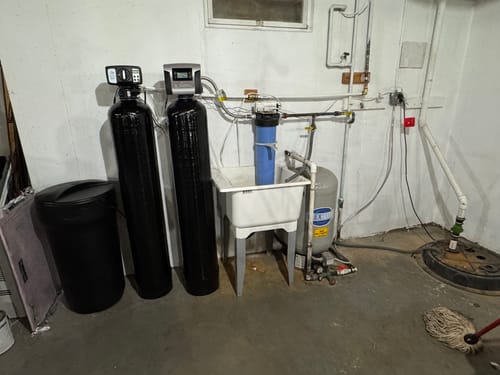
Now that we comprehend what a full panel tests for, let's focus on what actually drives the treatment decision.
Four results carry the most weight:
- Ferrous iron above 5 mg/L demands an air injection oxidation filter — a softener simply won't cut it
- Ferric iron above 3 mg/L requires a backwashing filter loaded with specialized media like Katalox, BIRM, or greensand
- Bacterial iron, revealed by reddish-brown slime or an oily sheen, means you're facing a two-step fight: shock chlorination first, then filtration
- pH, hardness, and manganese determine whether your chosen system will actually survive long-term
Miss any of these markers, and you'll install the wrong system — wasting money while your water stays compromised.
How pH, Hardness, and Manganese Determine Which Filter Media Works
Once you've identified your iron levels, three water chemistry variables — pH, hardness, and manganese — determine whether your chosen filter media will actually perform or fail prematurely.
pH is the biggest driver: acidic water below 6.8 favors pyrolox or greensand, while water above 7.0 enables the effectiveness of catalytic media like BIRM.
Hardness adds another layer of complexity. When hardness exceeds 10 grains per gallon, the media fouls rapidly unless you install a softener upstream first. Skip that step, and you're replacing media far sooner than necessary.
Manganese changes the equation entirely. It co-occurs with iron frequently, and removing both metals demands oxidizing media — catalytic carbon or greensand specifically. Matching your media to all three variables simultaneously is what separates a system that lasts from one that disappoints.
Match Your Test Results to the Right Iron Filter
With your water chemistry panel in hand, matching those numbers to the right iron filter becomes straightforward. Each result points directly to a solution:
- Ferrous iron under 5 mg/L? A water softener with iron removal capability handles it cleanly.
- Ferrous iron over 5 mg/L? You need an air injection oxidation (AIO) filter—the proven standard.
- Ferric iron between 3–15 mg/L? A backwashing iron filter with specialized media is your answer.
- Iron bacteria present? Shock chlorination first, then filtration—skipping step one means the bacteria wins.
We'd also flag colloidal iron—that stubborn pink tint that never settles—requiring a filter engineered specifically for ultra-fine particles. Your test results aren't just numbers; they're your roadmap to clean water.
When Bacteria, Sulfur, or Tannins Are Interfering With Iron Treatment
Sometimes your water chemistry panel throws you a curveball—iron isn't the only problem. Bacteria, sulfur, and tannins each sabotage iron removal differently, and missing them means your system will underperform or fail prematurely.
| Interfering Factor | How It Disrupts Iron Removal | Required Treatment Addition |
|---|---|---|
| Iron Bacteria | Produces biofilms, clogs equipment | Shock chlorination + filtration |
| Sulfur Compounds | Forms insoluble iron-sulfur particles | Oxidation + filtration |
| Tannins | Binds iron, blocks standard filtration | Specialty resin or carbon filters |
| Combined Bacteria + Sulfur | Accelerates pipe fouling | Sequential multi-stage treatment |
| Combined Tannins + Iron | Chemically locks iron in solution | Activated carbon + resin system |
Resolving these co-contaminants first safeguards your iron removal system's longevity and preserves consistent performance. Treat the full picture, not just the iron.
Frequently Asked Questions
What Is an Acceptable Iron Level in Well Water?
The EPA's secondary limit is 0.3 mg/L, but we'd consider anything under 1 mg/L manageable. Once you're hitting 5 mg/L or higher, you'll need more aggressive treatment solutions.
How to Interpret Well Water Test Results?
We'll examine iron, pH, hardness, manganese, sulfur, bacteria, and total dissolved solids together. Each measurement reveals specific treatment needs, helping us pinpoint whether you're dealing with ferrous, ferric, bacterial, or colloidal iron issues.
How Do You Know if Your Well Water Is High in Iron?
Our well water's high in iron when levels exceed 0.3 mg/L—the EPA's threshold. Watch for orange staining, metallic taste, or reddish discoloration as telltale signs before testing confirms it.
How to Test Iron Levels in Well Water?
We'll want to send a sample to a certified lab for the most accurate results. They'll measure iron in mg/L, distinguishing between ferrous and ferric types—critical knowledge for choosing the right treatment method.


