


![SoftPro™ Chlorine+ Carbon Whole House Water Filter to Remove PFAS, Chlorine, Chloramine & Pesticides [City Water Filters Series]](http://softprowatersystems.com/cdn/shop/files/SoftPro_Whole_House_Carbon_Filter_with_Spin_Down_Water_Filter.webp?v=1783547361&width=140)


 855-683-8488


How Well Water pH Affects Your Iron Filter Type and Media Choice

Your well water's pH does more than measure acidity—it actually determines what type of iron you're dealing with. Below pH 7.0, iron stays dissolved and invisible as ferrous iron. Above 7.0, it oxidizes into visible reddish-brown ferric particles. Each type demands different filter media, and choosing the wrong one means poor performance or outright failure. Understanding your exact pH number is the key to picking the right solution, and we'll show you exactly how.
Key Takeaways
- Well water pH below 7.0 keeps iron dissolved and invisible, while pH above 7.0 converts it to visible reddish-brown particles.
- Low pH suppresses iron oxidation, maintaining it in dissolved ferrous form; high pH accelerates oxidation into filterable ferric particles.
- Katalox-Light works at pH 6.0 and above, giving it the widest effective range among common iron filter media.
- Birm requires pH 6.8 minimum, Filox needs pH 7.0, and Greensand demands chemical additives regardless of pH level.
- Testing well water pH before selecting filter media prevents poor performance, system failure, and ensures long-term filtration efficiency.
How Your pH Level Determines Which Type of Iron You Have

When your well water's pH dips below 7.0, you're most likely dealing with ferrous iron — the sneaky, dissolved kind that's invisible until it leaves those frustrating reddish-brown stains on your sinks and laundry. It's clear in the glass but destructive over time.
Flip that equation, and once your pH climbs above 7.0, ferric iron takes over. Unlike its dissolved counterpart, ferric iron shows itself immediately as reddish-brown particles floating visibly in your water.
Why does this distinction matter? Because each iron type responds to different treatment media. Greensand filters target ferrous iron effectively, while oxidizing media like Katalox-Light handles ferric iron better. Getting your pH tested first isn't optional — it's the foundation of choosing a filter that actually works.
Why Low pH Produces Ferrous Iron and High pH Produces Ferric Iron
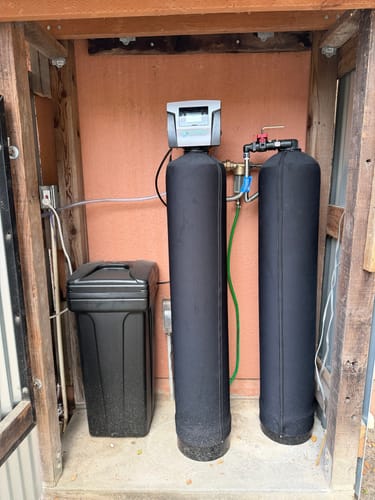
The chemistry behind this comes down to something surprisingly simple: oxygen availability. In low pH water, the acidic environment actually suppresses oxidation, keeping iron dissolved in its ferrous state. You can't see it, smell it, or filter it conventionally—it's fundamentally invisible until it hits air.
High pH water behaves differently. The alkaline environment accelerates oxidation, converting dissolved ferrous iron into ferric iron—those familiar rust-colored particles you can actually trap with standard filtration media.
Your treatment strategy hinges entirely on which form you're dealing with. Ferrous iron demands specialized media and chemistry to force oxidation before filtration occurs. Ferric iron's already done that work for you. Your water's pH essentially tells you which battle you're fighting.
Which Iron Filter Works Best at Your pH Level?
Most iron filters live or die by your water's pH—and knowing which media matches your specific reading saves you from buying equipment that underperforms or fails prematurely.
Katalox-Light performs reliably at pH 6.0 and above, requires no chemicals, and lasts 6–10 years—making it our strongest all-around recommendation. Birm demands a pH of at least 6.8, with 7.0 being ideal, and only lasts 3–5 years, so it's a narrower fit.
Greensand works across a broader range but requires ongoing chemical dosing and tops out at 5–8 years. Filox competes closely with Katalox-Light but needs extremely high backwash flow rates most residential systems can't sustain.
Match your pH reading to these requirements first, and you'll immediately eliminate the options that were never right for your water.
Which Filter Media Handles the Widest pH Range?
Now that you know which media matches specific pH readings, it's worth asking which one handles the broadest range—because that answer profoundly simplifies your decision. Katalox-Light operates effectively starting at pH 6.0, outperforming every competing media we've reviewed.
| Media | Minimum pH | Chemical Addition Required |
|---|---|---|
| Katalox-Light | 6.0 | No |
| Birm | 6.8 | No |
| Filox | 7.0 | No |
Greensand requires chemical additives regardless of pH, making it a separate consideration entirely. When your well water skews acidic, Katalox-Light's lower threshold means you're far less likely to need pre-treatment adjustments before filtration. That flexibility translates directly into fewer components, lower installation complexity, and a system that simply works across conditions where other media would struggle or fail outright.
What to Do If You Don't Know Your Well Water pH?
If you don't know your well water pH, the fix is straightforward: get it tested. Without that number, you're guessing—and guessing wrong means choosing a filter that underperforms or fails entirely.
A basic water test gives you the pH data you need to match your water to the right media. Here's what that knowledge reveals:
- Confirming compatibility – knowing whether your pH clears the 6.0 threshold for Katalox-Light or the stricter requirements of Filox
- Avoiding costly mistakes – selecting a system that actually works with your water chemistry from day one
- Optimizing performance – ensuring your iron removal system operates at peak efficiency long-term
Don't skip this step. One test eliminates the guesswork and points you directly toward the right solution.
Frequently Asked Questions
What Is the Best Filter for Removing Iron From Well Water?
We recommend Katalox-Light media in an air-injection system. It's chemical-free, works at pH 6.0+, and outlasts Birm and Greensand while requiring lower backwash rates than Filox—making it your most effective whole-house iron removal solution.
What Are Common Problems With Iron Filters?
We've seen iron filters fail due to wrong media selection, insufficient backwash flow, neglected maintenance, poor regeneration, and system incompatibility with water conditions. These issues reduce effectiveness and cause premature filter failure.
What Is a Safe Level of Iron in Well Water?
We consider 0.3 mg/L the EPA's safe threshold, but levels up to 0.6 mg/L remain tolerable. Beyond that, you'll need treatment—and knowing whether it's ferrous or ferric iron determines your filter approach.
What Is the Best Whole House Iron Filter for Well Water?
For acidic well water with pH 6.0+, we recommend an air-injection oxidation system using Katalox-Light media. It removes iron, manganese, and hydrogen sulfide without chemicals, lasting 6-10 years — making it our top whole house choice.


