


![SoftPro™ Chlorine+ Carbon Whole House Water Filter to Remove PFAS, Chlorine, Chloramine & Pesticides [City Water Filters Series]](http://softprowatersystems.com/cdn/shop/files/SoftPro_Whole_House_Carbon_Filter_with_Spin_Down_Water_Filter.webp?v=1783547361&width=140)


 855-683-8488


Iron Filter Media Density and Backwash Flow: How Media Type Affects Design

The media inside your iron filter directly controls how much backwash flow you need — and that relationship starts with density. Denser media like solid manganese dioxide requires 10–12 gpm/ft² to fluidize properly, while coated media like Greensand fluidizes at lower rates. Get that number wrong, and you're looking at channeling, compaction, and shortened service runs. Understanding exactly how each media type behaves under backwash pressure is what separates a reliable system from a frustrating one.
Key Takeaways
- Denser media like solid manganese dioxide requires higher backwash flow rates of 10–12 gpm/ft² to achieve proper fluidization and cleaning.
- Greensand, a coated manganese media, fluidizes at lower backwash rates of 8–10 gpm/ft² due to its reduced density.
- Mismatched backwash flow causes channeling, media compaction, and shortened service runs, creating serious long-term reliability problems.
- To select the right media, divide available backwash flow in gpm by the filter's cross-sectional area in square feet.
- Density alone doesn't determine backwash requirements — Birm requires 10–12 gpm/ft² despite being lighter than solid manganese dioxide.
Why Media Density Controls Iron Filter Backwash Flow Requirements

When it comes to iron filter backwash systems, media density calls the shots. Here's why: denser media simply resists movement, demanding higher flow rates to achieve proper fluidization. Think of it like trying to stir wet sand versus dry leaves—they're not remotely comparable.
Solid manganese dioxide media like Filox, weighing 120-140 lbs/ft³, requires backwash rates of 10-12 GPM/ft² to adequately lift and expand the bed. Lighter alternatives like Greensand? They'll fluidize at considerably lower rates.
Why does this matter? If your backwash flow falls short, trapped particulates stay embedded, media compaction follows, and filter performance degrades. Getting the density-to-flow relationship right isn't optional—it's the foundation of your entire backwash system design. Choose incorrectly, and you're engineering failure from day one.
Backwash Flow Rates for Every Iron Filter Media Type
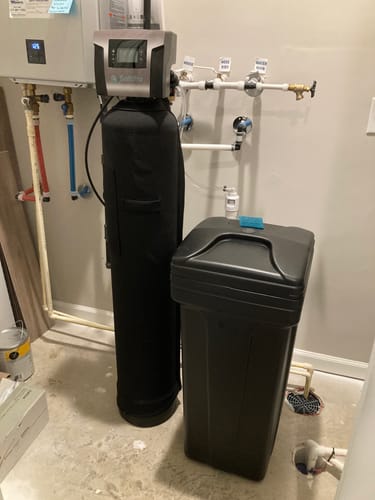
Choosing the right backwash flow rate starts with knowing your media. Each media type has distinct density characteristics that directly dictate how aggressively you need to backwash. Get it wrong, and you're either channeling the bed or wasting water.
Backwash flow rate starts with media density. Get it wrong, and you're channeling the bed or wasting water.
Here's what the numbers actually look like:
- Pro-OX, Filox, and Pyrolox (solid manganese dioxide): 10–12 gpm/ft² — high density demands high flow
- Greensand (coated manganese media): 8–10 gpm/ft² — lower density, lower threshold
- Birm (lightweight media): 10–12 gpm/ft² — paradoxically matches solid MnO₂ rates despite lower density
Notice that Birm and solid manganese dioxide share a flow range but for completely different reasons — density isn't the only variable. Understanding why each media requires its specific rate separates competent system designers from guessers.
Solid Manganese Dioxide vs. Coated Media: Density and Backwash Compared
Two media types dominate the iron filtration conversation — solid manganese dioxide and coated manganese — and their density difference explains almost everything. Solid manganese dioxide, like Pro-OX, runs 120–140 lbs/ft³ with purity exceeding 80%. That density enables service flow rates up to 5 gpm/ft², while coated media typically caps at 3.5–5 gpm/ft².
But density cuts both ways. A denser bed demands more aggressive backwashing — 10–12 gpm/ft² versus 8–10 gpm/ft² for coated media. If you undersize that backwash, you're leaving trapped solids behind.
The trade-off is straightforward: solid manganese dioxide oxidizes iron more aggressively and lasts longer, but it costs more upfront and demands more hydraulic muscle to maintain. Coated media is gentler on system design but less powerful where iron loads are heavy.
What Happens When Backwash Flow Rate Doesn't Match Your Iron Filter Media?
Density differences between media types aren't just academic — they've real consequences when your backwash flow rate doesn't line up with what your media actually needs. Run too little flow through dense manganese dioxide, and the bed simply won't fluidize. What follows degrades your system's performance fast:
- Channeling — water carves preferential paths, bypassing trapped iron entirely
- Media compaction — particles pack tighter over time, restricting flow and contact
- Shortened service runs — fouled media forces more frequent backwashes, straining your system
Birm's lower density means it fluidizes easily at 8–10 gpm/ft², but manganese dioxide demands 10–12 gpm/ft² to clean properly. Mismatching these numbers isn't a minor inefficiency — it's a reliability problem you'll feel in every service cycle.
How to Match Iron Filter Media Density to Your Available Flow Capacity
Before you select a media, you'll want to confirm what your system can actually deliver during backwash — because that number drives everything else. Start by measuring your available backwash flow rate in gpm, then divide by your filter's cross-sectional area in square feet. That gives you gpm/ft².
From there, matching becomes straightforward. If you're working with 10-12 gpm/ft², Birm or Greensand are your reliable options. Push into the 12-15 gpm/ft² range, and you can confidently run Filox or Pyrolox — the denser, more aggressive manganese dioxide media.
We've seen systems fail simply because someone chose Filox without verifying flow capacity. Don't let media density be an afterthought. Let your available flow rate make the decision for you.
Frequently Asked Questions
What Are the Three Types of Filter Media?
We've got three types to know: solid manganese dioxide (like Pro-OX and Filox), coated manganese media (like Greensand), and Birm. Each one's got unique properties that'll shape your filter system's design.
What Is the Typical Flow Rate for a Filter Backwash?
The typical backwash flow rate for a filter ranges from 8 to 20 gpm/ft², depending on the media type we're using. Getting this rate right guarantees we're properly flushing the bed without losing valuable media.
How to Calculate Filter Media?
To calculate filter media, we'll multiply the filter vessel's cross-sectional area (ft²) by the desired bed depth (ft). This gives us the total media volume needed, which we then convert using the media's specific density.
What Type of Media Is Used to Remove Iron From Water?
We'll find that solid manganese dioxide media like Pro-OX, Filox, and MangOX are the most effective for iron removal, outperforming coated options like Greensand due to their superior purity and density.


