


![SoftPro™ Chlorine+ Carbon Whole House Water Filter to Remove PFAS, Chlorine, Chloramine & Pesticides [City Water Filters Series]](http://softprowatersystems.com/cdn/shop/files/SoftPro_Whole_House_Carbon_Filter_with_Spin_Down_Water_Filter.webp?v=1783547361&width=140)


 855-683-8488


Iron Filter Tank and Valve Mismatch: What Happens If You Swap Only One

Swapping just the tank or the valve in your iron filter system seems like a cost-saving shortcut, but it almost always creates bigger problems than it solves. A mismatched pairing throws off backwash cycles, disrupts flow rates, strains seals, and can leave your iron levels just as high as before. The two components are engineered to work as a unit, and what happens when you separate them might surprise you.
Key Takeaways
- Replacing only the tank can cause backwash and regeneration cycles to fall out of sync with the mismatched valve.
- Swapping only the valve risks improper flow rates, leading to channeling and premature media exhaustion in the old tank.
- A seal failure between a mismatched tank and valve creates leaks and pressure imbalances that disrupt filtration timing.
- Tank degradation transfers hidden stress to a new valve, accelerating wear and triggering the next system failure sooner.
- Replacing both components together ensures correct sizing, compatibility, warranty protection, and long-term system reliability.
How to Tell If Your Iron Filter Tank and Valve Are Mismatched

Spotting a mismatch between your iron filter tank and valve isn't always obvious, but a few telltale signs can tip you off before the problem gets worse. Start by cross-referencing your tank and valve model numbers against their specifications — compatibility isn't assumed, it's confirmed.
From there, watch for physical red flags: leaks around the valve, pressure inconsistencies, or a valve that won't fully open or close. These aren't minor quirks; they're symptoms. You'll also want to test your water — if iron levels remain high despite the system running, the backwash cycle likely isn't performing correctly.
When symptoms are subtle or overlapping, don't guess. A professional inspection cuts through the ambiguity and points you toward the right fix.
Why Compatibility Between Tank and Valve Matters
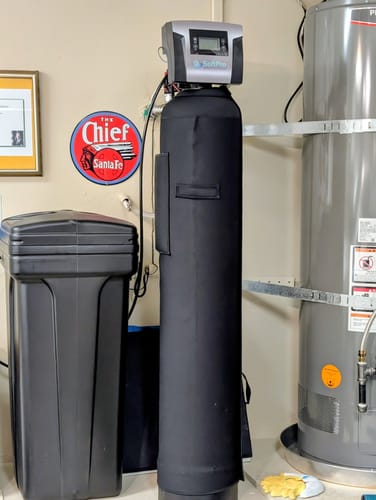
Once we're aware of what to look for, the next question becomes: why does any of this happen in the first place? Compatibility isn't just a recommendation — it's the foundation of a functioning system. Here's what's actually at stake:
Compatibility isn't just a recommendation — it's the foundation everything else depends on.
- Backwash efficiency — a matched valve delivers the exact force needed to flush iron deposits completely
- Flow rate balance — mismatched components create pressure inconsistencies that compromise water quality
- Valve integrity — undersized valves facing oversized tanks develop damaging backpressure over time
- Cycle accuracy — oversized valves trigger premature backwash, wasting water and shortening run time
- System longevity — proper pairing directly extends your filter's lifespan and sustains peak performance
Every component speaks a specific hydraulic language. When they don't match, the entire system pays the price.
What Breaks When You Replace Only the Iron Filter Tank
The temptation to replace only the iron filter tank makes sense on the surface — it's the part you can see cracking, corroding, or failing. But the moment you pair a new tank with an old valve, you've introduced a mismatch the system can't ignore.
Here's what actually breaks: the backwash and regeneration cycles fall out of sync, leaving iron in your water. The seal between tank and valve fails, letting unfiltered water bypass the system entirely. Pressure imbalances throw off filtration timing. And your old valve, now working against incompatible specs, wears out faster than it should.
You haven't saved money — you've scheduled your next failure. The tank and valve aren't independent parts. They're a system, and systems don't negotiate compromises well.
What Breaks When You Replace Only the Iron Filter Valve
Flip the scenario around, and the same trap opens from the other side. Swap just the valve while keeping the old tank, and you've introduced a calibration mismatch that quietly dismantles performance from within.
Here's what actually breaks:
- Backwash cycles misfire — the new valve's timing doesn't match the tank's capacity, leaving trapped iron behind
- Flow rates fall out of range — pressure drops and contact time go sideways, starving the media of proper regeneration
- Channeling forms — water carves shortcuts through the media instead of filtering evenly
- Media exhausts prematurely — without correct cycling, the filtration bed burns out faster
- Warranty disappears — manufacturers won't cover a hybrid system, and troubleshooting becomes nearly impossible
One mismatched valve unravels the entire system's logic.
When to Replace Your Iron Filter Tank and Valve Together
Both failure paths lead to the same conclusion: replace the tank and valve together, or risk building the next problem into the fix itself. Manufacturers design these components as integrated systems — mismatched specs quietly destroy performance before you even notice.
Here's when simultaneous replacement isn't optional:
| Scenario | What's Happening | Why Both Must Go |
|---|---|---|
| Tank is aging, valve still works | Tank degradation stresses the valve | Mismatched wear accelerates failure |
| Valve is upgraded, tank is old | New flow rates overwhelm old tank | System imbalance causes backwash failure |
| Either component is damaged | Hidden stress transfers to the other | Partial replacement delays full breakdown |
We always recommend consulting a professional before purchasing. Correct sizing and compatibility protect your warranty, your water quality, and your investment.
Frequently Asked Questions
How Often Should an Iron Filter Backwash?
We recommend backwashing your iron filter every 7-14 days, though heavily iron-laden water demands more frequent cycles. Monitor your flow rate and pressure—they'll tell you exactly when your system's crying out for attention.
What Happens if a Water Filter Is Installed Backwards?
If you install a water filter backwards, you'll bypass the filter media entirely, letting unfiltered water flow through your system. You'll also risk damaging internal components, causing leaks, pressure issues, and compromised water quality.
What Kills Iron in Water?
We kill iron in water through oxidation—oxygen, chlorine, or catalytic media like manganese greensand convert dissolved ferrous iron into solid ferric iron, which we then filter out. Ion exchange resins and iron-eating bacteria also tackle the problem effectively.
How to Rebed an Iron Filter?
We drain the tank, pull the exhausted media, scrub it clean, then refill it with fresh, manufacturer-specified media—layering it precisely for ideal flow distribution and iron contact time. It's surgical work that rewards precision.


