


![SoftPro™ Chlorine+ Carbon Whole House Water Filter to Remove PFAS, Chlorine, Chloramine & Pesticides [City Water Filters Series]](http://softprowatersystems.com/cdn/shop/files/SoftPro_Whole_House_Carbon_Filter_with_Spin_Down_Water_Filter.webp?v=1783547361&width=140)


 855-683-8488


Iron From Your Aquifer vs Iron From Your Pipes: How to Tell the Difference

If your iron problem affects every tap equally, it's likely coming from your aquifer—groundwater carrying dissolved iron into your home. If discoloration only shows up at certain fixtures or clears after running the water briefly, corroded pipes are probably to blame. The fix for each is completely different, so identifying the source first saves you time and money. Keep going and we'll show you exactly how to tell them apart.
Key Takeaways
- Iron enters water from two sources: natural leaching from iron-rich aquifer minerals or corrosion shedding from iron and steel pipes.
- Aquifer iron causes uniform discoloration at every tap, while pipe corrosion iron causes inconsistent discoloration limited to specific fixtures or locations.
- Aquifer iron appears clear when drawn but turns yellow, orange, or reddish-brown after exposure to air.
- Testing well water directly before it enters household plumbing reveals whether the aquifer or pipes are the iron source.
- Aquifer iron requires whole-home point-of-entry treatment, while pipe corrosion iron may only need localized plumbing repairs or point-of-use filters.
How Iron Gets Into Your Water: Aquifer vs Corroded Pipes

Whether you're dealing with rusty stains in your sink or discolored water from your tap, the first step to fixing the problem is understanding where that iron is actually coming from. There are two primary culprits: your aquifer and your plumbing.
Iron-rich minerals in surrounding soil and rock naturally leach iron into groundwater aquifers. That iron typically shows up as ferrous iron — clear when drawn but turning red-brown upon exposure to air.
Iron leaches naturally from mineral-rich soil and rock into groundwater — appearing clear at first, then turning red-brown in air.
Corroded iron or steel pipes, however, introduce iron differently. As pipes deteriorate, they shed iron directly into your water, causing discoloration and staining regardless of what's happening underground.
Why does this distinction matter? Because each source demands a completely different fix — and misidentifying the cause wastes time and money.
Aquifer Iron: Discoloration That Affects Every Tap in the House
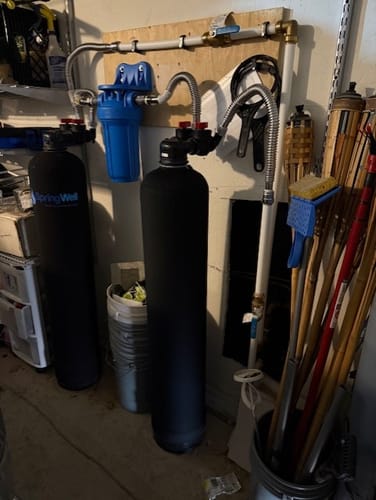
If the iron in your water is coming from the aquifer, you'll notice something telling: every faucet in your home runs the same discolored water. That uniformity is your first clue. Aquifer iron typically enters as dissolved ferrous iron, which means it's invisible at first. The water looks clear when it leaves the tap, then oxidizes and turns yellow, orange, or reddish-brown once it hits air. That's iron doing exactly what iron does.
Left untreated, it stains sinks, toilets, and laundry while quietly degrading your appliances. Because the source is upstream of everything, no localized fix will solve it. You'll need a whole-home filtration system designed specifically to intercept iron before it reaches any tap in the house.
Pipe Corrosion Iron: Discoloration That Varies by Fixture or Location
Pipe corrosion tells a different story than aquifer iron, and the location of your discoloration is what gives it away. When rust-colored water appears at one sink but runs clear everywhere else, the aquifer isn't your culprit—a specific fixture or pipe run is.
Notice how the discoloration varies between your kitchen, bathroom, and laundry room? That inconsistency points directly to your home's internal plumbing, not the water source itself.
Here's another useful diagnostic: watch what happens when you let the water run. If it starts discolored but clears up after a minute, you're seeing corrosion particles flushing out of a localized section of pipe. Aquifer iron doesn't behave that way—it stays consistent because it's dissolved throughout your entire water supply.
Test Your Well vs Your Taps to Pinpoint the Source
Once you've narrowed down whether the problem is location-specific or system-wide, the next step is to test the water itself. Start by pulling a sample directly from your well before it passes through any household plumbing. Then compare it against samples from your taps.
If the well water tests clean but your tap water shows elevated iron, your pipes are the culprit. If both samples are iron-rich, the aquifer is the source.
An on-site test can quickly distinguish ferrous iron (clear water that oxidizes red) from ferric iron (already visibly red), giving you an early directional clue. For a complete picture, send samples to a certified lab. Knowing the origin means you'll choose the right treatment the first time.
How to Fix Aquifer Iron and Pipe Iron Differently
Treating iron effectively means matching your solution to the source. If it's coming from your aquifer, you'll need oxidation and filtration—typically a point-of-entry system that treats every drop entering your home before it touches a pipe or fixture. That's the only way to stay ahead of dissolved ferrous iron that oxidizes on contact with air.
If your pipes are the culprit, the fix looks completely different. You might replace corroded plumbing, install a scale-inhibiting system, or add a targeted point-of-use filter where it matters most. Wholesale whole-home treatment often isn't necessary.
This is exactly why testing at the well head first matters so much. Skipping that step means you're guessing—and guessing usually means spending money on solutions that won't last.
Frequently Asked Questions
How to Identify Iron in Water?
Fill a clear glass from your faucet and watch it. If it's clear but turns orange after sitting, you've got ferrous iron. Already discolored? That's ferric iron showing itself immediately.
What Will Remove Iron From Well Water?
We've got several effective options to remove iron from well water: air injection or potassium permanganate oxidizing filters, manganese greensand media, Katalox-Light systems, or whole-house point-of-entry filtration—the most extensive solution for high iron levels.
Can You Get Too Much Iron From Well Water?
Yes, you can get too much iron from well water. If levels exceed 0.3 mg/L, you'll risk gastrointestinal distress, constipation, and potentially hemochromatosis—a dangerous buildup of iron in your organs. Testing your water is essential.
Is It Safe to Drink Well Water That Has Iron in It?
Yes, we can safely drink well water containing iron—up to 0.3 mg/L meets EPA standards. While higher levels cause taste and staining issues, they're rarely dangerous unless they exceed 5-10 mg/L.


