


![SoftPro™ Chlorine+ Carbon Whole House Water Filter to Remove PFAS, Chlorine, Chloramine & Pesticides [City Water Filters Series]](http://softprowatersystems.com/cdn/shop/files/SoftPro_Whole_House_Carbon_Filter_with_Spin_Down_Water_Filter.webp?v=1783547361&width=140)


 855-683-8488


Iron in Water Heater From Well Water: What It Costs and How to Know

If your home runs on well water, iron is likely sneaking into your water heater right now — and you'd never know until serious damage appears. Dissolved iron oxidizes inside your tank, building reddish-brown scale, corroding the lining, and burning out heating elements years too early. Left unchecked, it can cut your water heater's lifespan in half, costing up to $5,400 in premature replacement. What happens next depends entirely on your iron concentration level.
Key Takeaways
- Well water carries dissolved ferrous iron that oxidizes inside your water heater, creating rust, scale, and sludge that damage components over time.
- Reddish-brown buildup coats tank walls and heating elements, reducing efficiency, restricting water flow, and causing premature equipment failure.
- Iron contamination can halve your water heater's lifespan, with premature replacement costing up to $5,400 compared to $150–$250 annual maintenance.
- Professional water testing determines your exact iron type and concentration, which dictates whether you need a softener, oxidation filter, or greensand filter.
- Choosing the wrong filtration method underperforms against your specific iron problem, risking continued damage and unnecessary long-term costs.
How Iron From Well Water Gets Into Your Water Heater

When you rely on well water, iron is almost always part of the deal. It dissolves from iron-bearing minerals and rocks directly into the groundwater feeding your well, hitching a ride straight into your home's plumbing.
That dissolved iron — called ferrous iron — stays invisible until it contacts air inside your water heater. Then it oxidizes into ferric iron, the rusty, particulate form that stains and clogs. Meanwhile, bacterial iron adds another layer of trouble, producing a slimy biofilm that coats your tank's interior and plumbing components.
The result? Scale buildup accumulates inside your water heater, quietly strangling its efficiency and shortening its lifespan — often long before you realize iron's the culprit.
What Iron Damage Actually Looks Like Inside a Tank
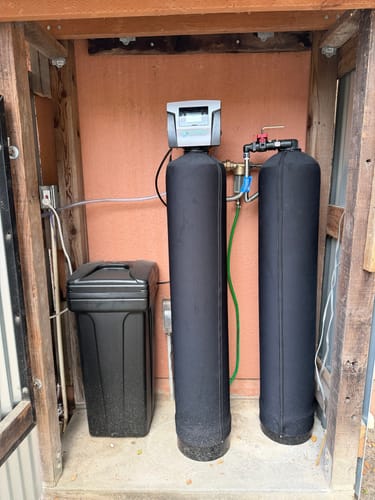
Picture what's happening inside a tank that's been processing iron-laden well water for years. It's not pretty, and understanding the damage helps you act before it's too late.
Reddish-brown scale and sludge coating tank walls and heating elements
Reddish-brown scale and sludge don't just look alarming — they're actively destroying your tank from the inside out.
Corroded interior lining creating vulnerable spots that eventually leak and fail
Blocked heat exchangers restricting water flow and strangling efficiency
Overheating elements burning out prematurely under accumulated iron particles
Reduced tank capacity delivering less hot water as fouling worsens over time
Each symptom compounds the others. Scale insulates heating elements, forcing them to work harder, accelerating corrosion, which accelerates failure. Once you recognize this chain reaction, you'll understand why early intervention matters enormously.
What Your Iron Concentration Means for Water Heater Risk
Not all iron is created equal, and the concentration in your well water determines whether you're dealing with a minor nuisance or a serious threat to your water heater's lifespan. Ferrous iron under 2-5 mg/L might surrender to a standard water softener, but push past that threshold and you'll need an air injection oxidation filter.
Ferric iron behaves differently—once it exceeds 3 mg/L, you're looking at backwashing filters loaded with specialized media like Katalox or greensand. Bacterial iron operates by its own destructive rules entirely, building biofilm that chokes plumbing regardless of concentration. And colloidal iron? It laughs at basic filtration.
The only way to know exactly what you're fighting is professional water testing—guessing costs far more than the test ever will.
What Iron Contamination Actually Costs Your Water Heater
Once we're aware of what type of iron we're dealing with and how much of it's flowing through our pipes, the next logical question is brutally simple: what's this actually costing us?
Here's the financial reality:
- Iron buildup can slash a water heater's 10-15 year lifespan in half
- Premature replacement runs up to $5,400
- Neglecting filtration triggers accelerated corrosion, with a break-even point around six years
- Preventative maintenance costs just $150-$250 annually
- Proactive filtration preserves over $1,000 in annual efficiency savings
The math isn't complicated. We're choosing between spending $150-$250 now or absorbing thousands later. Professional service consistently outperforms DIY patching, and repair costs exceeding 50% of replacement value signal it's time to replace entirely. Iron contamination isn't a minor inconvenience—it's a slow financial drain.
Which Iron Filter Actually Protects Your Water Heater?
Now that we comprehend what iron contamination is costing us, let's cut through the noise on filtration options—because not all iron filters are created equal, and choosing the wrong one is like locking the barn door after the horse has bolted.
Here's what actually works: Air injection oxidation filters dominate against high ferrous iron levels, keeping your water heater alive longer. Manganese greensand filters handle both ferrous and ferric iron up to 15 mg/L—versatile and reliable. Water softeners? They'll manage iron under 2-5 mg/L, nothing more. Sediment filters won't touch dissolved iron at all—they're essentially decorative at this point.
The wrong choice doesn't just underperform; it quietly invites scaling, corrosion, and a premature $1,000+ replacement bill you never saw coming.
Frequently Asked Questions
How Much Does It Cost to Remove Iron From Well Water?
We're looking at $800 to $5,400 for an iron filtration system, with professional installation adding $1,500 to $3,500. Combine it with a water softener, and you'll spend up to $7,500 total.
How Do I Know if My Well Water Is High in Iron?
We can spot high iron by watching for water that turns red after sitting, red or orange straight from the tap, slimy brown residue in toilet tanks, or a pink tinge that won't settle.
What Is the Cheapest Way to Remove Iron From Well Water?
The cheapest option we'd recommend is an air injection oxidation (AIO) filter, running $1,800–$2,500 installed. It's a proven single-system solution that tackles dissolved iron without the recurring chemical costs of alternatives.
Is It Safe to Drink Well Water That Has Iron in It?
Yes, drinking well water with iron is generally safe! The EPA classifies iron as a secondary contaminant, meaning it's an aesthetic issue—not a health hazard—unless you have hemochromatosis or you're feeding an infant.


