


![SoftPro™ Chlorine+ Carbon Whole House Water Filter to Remove PFAS, Chlorine, Chloramine & Pesticides [City Water Filters Series]](http://softprowatersystems.com/cdn/shop/files/SoftPro_Whole_House_Carbon_Filter_with_Spin_Down_Water_Filter.webp?v=1783547361&width=140)


 855-683-8488


Manufactured Home Well Water Iron Filter Drain Line Challenges

Installing an iron filter drain line in a manufactured home means solving problems most installation guides ignore. We're talking tight crawl spaces with only 18 inches of clearance, vapor barriers that puncture easily, and drain lines sharing space with other household plumbing. Flex pipe resists clean fittings, low headroom limits your options, and backflow risks hide until damage is already done. Every manufactured home tells its own plumbing story — and understanding yours changes everything.
Key Takeaways
- Manufactured home crawl spaces often have under 18 inches of clearance, making drain line routing physically difficult and time-consuming.
- Corrugated flex pipe common in manufactured homes resists clean fittings and traps sediment, complicating reliable drain connections.
- Shared drain lines can cause backpressure and overflow when iron filter backwash volume exceeds the system's capacity.
- Without a proper air gap or check valve, backflow can contaminate your water supply silently and cause serious damage.
- Iron buildup, kinked tubing, and improper slope combine to cause incomplete regeneration cycles and long-term equipment failure.
Tight Crawl Spaces and Vapor Barriers That Complicate Iron Filter Drain Lines

Crawling through the underbelly of a manufactured home to install an iron filter drain line is one of those jobs that sounds straightforward until you're actually down there, face-to-face with a 18-inch clearance and a vapor barrier that crinkles and tears if you look at it wrong. Puncture that barrier carelessly, and you've traded one problem for a moisture infiltration nightmare.
We've seen installers route drain lines beautifully overhead, only to discover there's no compliant exit point without compromising the barrier's integrity. The solution usually involves carefully cutting and resealing the vapor barrier around a fitted penetration point, then routing the line toward a sump or daylight exit. Tight spaces demand patience, the right low-profile fittings, and a plan before you ever squeeze underneath.
Low Clearance, Flex Pipe, and Shared Drains Blocking Your Filter Setup
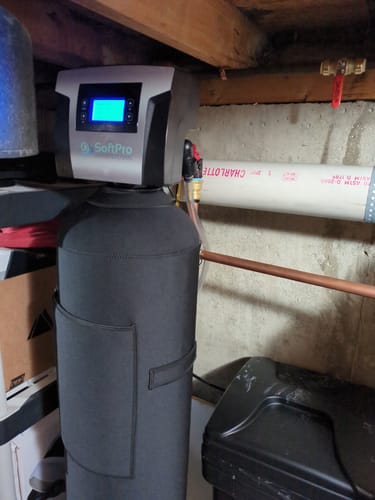
The tight crawl space gets the attention, but it's often the trio of low clearance, aging flex pipe, and shared drain lines that quietly kills a clean iron filter installation before it ever gets started.
When headroom drops below fourteen inches, routing a dedicated drain line becomes a puzzle with no elegant solution. Flex pipe — that corrugated plastic staple of manufactured home plumbing — resists clean fittings and loves to trap backwash sediment in its ridges.
Then there's the shared drain scenario: one line already carrying laundry, softener, and utility sink discharge. Stack an iron filter's backwash cycle on top of that, and you're asking for slow drains, backpressure, and overflow.
Each obstacle compounds the others, turning what looks like a simple connection into a genuine engineering problem.
Where to Route Your Iron Filter Drain Line in a Manufactured Home
Once one comprehends what's working against us, we can start asking the better question: where does the drain line actually go? In manufactured homes, we're working with fewer options than a site-built house, but we're not without solutions.
The most common routes include running the drain line to a utility sink, tying into an existing standpipe, or running it outside to a dry well or French drain. Each path carries trade-offs. A utility sink works beautifully until backwash volume overwhelms it. A standpipe requires proper air gaps. An outdoor route raises freezing concerns in colder climates.
We've got to match the route to the home's actual layout, not the ideal one. That distinction separates a system that functions from one that fails quietly over time.
Backflow and Clogging Problems Your Drain Line Setup Can Cause
Even if we've picked the right drain route, a poorly configured line can turn a working system into a slow-moving problem we don't notice until damage is already done. Two culprits dominate: backflow and clogging.
| Problem | Root Cause | Consequence |
|---|---|---|
| Backflow | No air gap or check valve | Contaminated water re-enters system |
| Sediment clog | Iron buildup inside drain line | Backwash cycle fails silently |
| Slow drain | Undersized or kinked tubing | Incomplete regeneration, iron breakthrough |
Backflow sneaks in when discharge water has nowhere to go but backward. Clogs build gradually—oxidized iron coating the interior until flow nearly stops. Neither announces itself loudly. That's what makes them dangerous in manufactured homes where plumbing access is already limited.
When Drain Line Complexity in Your Manufactured Home Requires a Pro
Sometimes a drain line job stops being a weekend project the moment we pull back the access panel and find a maze of existing lines running in directions that don't match any standard diagram. Manufactured homes surprise us constantly.
Here's when we call a pro:
- Confined spaces make repositioning drain lines physically impossible without specialized tools and experience.
- Existing configurations create backflow risks that only a licensed plumber can properly reroute and safeguard.
- Improper slope corrections require precise calculations to prevent pooling, slow drainage, or flooding near the filter system.
An experienced plumber doesn't just connect pipes — they read the home's unique plumbing story and write the next chapter correctly. Getting this wrong means water damage, failed equipment, and costly repairs we could've avoided entirely.
Frequently Asked Questions
What Are Common Problems With Iron Filters?
We've seen iron filters struggle with clogged drain lines, exhausted media from excessive iron, improper sizing, poor maintenance reducing effectiveness, and compatibility issues with other treatment equipment — all causing frustrating performance failures you'll want to avoid.
How Often Should an Iron Filter Backwash?
We recommend backwashing your iron filter every 2-3 days, though high iron concentrations may demand more frequent cycles. Your water usage, iron levels, and filter size all influence the ideal schedule—always follow your manufacturer's specific guidelines.
What Is the Best Way to Filter Iron Out of Well Water?
We recommend whole-house oxidation and filtration systems as your best iron-removal solution. They'll tackle iron, manganese, and sulfur simultaneously. However, first test your water — your iron levels determine whether you'll need additional options like water softeners or RO systems.
Should an Iron Filter Be Installed Before or After a Water Softener?
Install your iron filter before the water softener. Iron clogs and damages softener resin beads, reducing their effectiveness. We protect the softener by letting the iron filter tackle the heavy work first.


