


![SoftPro™ Chlorine+ Carbon Whole House Water Filter to Remove PFAS, Chlorine, Chloramine & Pesticides [City Water Filters Series]](http://softprowatersystems.com/cdn/shop/files/SoftPro_Whole_House_Carbon_Filter_with_Spin_Down_Water_Filter.webp?v=1783547361&width=140)


 855-683-8488


Ozone Iron Filter for Bacterial Iron: Does It Outperform Air Injection?

When bacterial iron clogs your pipes with slime and stains your fixtures, ozone iron filters outperform air injection in every way that matters. Ozone attacks biofilms directly, eliminates iron and sulfur bacteria, and oxidizes dissolved iron, manganese, and hydrogen sulfide faster than air injection ever can. Air injection simply can't break through the protective sheaths bacteria build. If you're dealing with persistent contamination, ozone is the stronger solution — and there's much more you'll want to know.
Key Takeaways
- Ozone attacks iron bacteria biofilms directly, breaking down cellular structures where air injection fails to penetrate protective slime sheaths.
- Air injection oxidizes dissolved iron but plateaus against higher bacterial iron concentrations, while ozone scales effectively with demand.
- Ozone actively suppresses iron and sulfur bacteria growth within the filter bed, keeping media biologically clean between cycles.
- Unlike air injection, ozone converts dissolved iron, manganese, and hydrogen sulfide into filterable particles faster and more completely.
- For persistent slime, recurring contamination, or iron above 7 ppm, ozone outperforms air injection as a long-term solution.
What Is Bacterial Iron and Why Standard Filters Fail

Bacterial iron sneaks into your water supply when iron-oxidizing bacteria latch onto dissolved iron and use it as fuel, creating a slimy, rust-colored mess that clogs pipes, stains fixtures, and makes your water smell foul. Unlike clear water iron, which simply precipitates as a solid, bacterial iron bonds directly to bacterial cell walls, making it far harder to capture.
Standard air injection filters can't keep up. The bacteria-produced slime rapidly coats the filter media, causing premature clogging and forcing frequent maintenance. Chlorine treatments offer a temporary fix, killing bacteria on contact, but once the chlorine dissipates, dissolved iron returns. You're stuck in a cycle of treating symptoms rather than solving the problem. That's precisely why a more aggressive oxidation approach is necessary.
How Ozone Iron Filters Oxidize and Remove Bacterial Iron
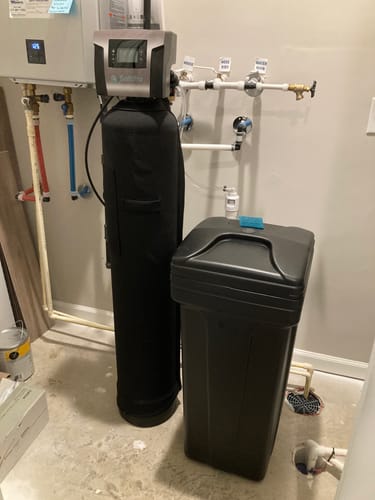
Where standard filters fall short, ozone steps in as a far more aggressive oxidizer. It doesn't just neutralize dissolved iron and manganese—it obliterates bacterial iron colonies that conventional systems can't touch.
Ozone doesn't just filter—it obliterates the bacterial iron colonies that conventional systems can't touch.
Oxidation on contact: Ozone converts dissolved iron, manganese, and hydrogen sulfide into insoluble particles faster than air injection alone.
Continuous media sanitization: The ozone environment actively suppresses iron and sulfur bacteria growth directly within the filter bed.
Integrated design: Ozone generation is built into the control valve itself, removing the complexity of chemical injection systems.
The result? A self-sustaining filtration system that handles up to 6 ppm of combined iron and hydrogen sulfide while keeping the media bed biologically clean between regeneration cycles.
Air Injection vs. Ozone Iron Filters for Bacterial Iron
Ozone's ability to eliminate bacterial iron colonies sets a high bar—but how does it actually stack up against air injection, the more common alternative?
Air injection oxidizes ferrous iron effectively, but it struggles against bacterial iron. Iron bacteria create protective biofilm sheaths that air simply can't penetrate deeply enough to destroy. Ozone, however, attacks those biofilms directly, breaking down cellular structures and eliminating the bacterial colonies at their source.
We also see air injection fall short in higher-concentration scenarios. It plateaus. Ozone scales with demand, delivering consistent oxidation power regardless of iron load.
For homeowners dealing with persistent slime, clogged pipes, or recurring contamination after air injection treatments, ozone isn't just a marginal upgrade—it's a fundamentally more capable solution designed for exactly this problem.
When to Choose an Ozone Iron Filter for Your Well
Knowing when ozone is the right call comes down to what's actually in your water. If your test results show iron above 7 ppm, persistent hydrogen sulfide odor, manganese, or recurring iron bacteria slime, ozone's the stronger choice.
Here's what makes it the right fit:
- Heavy contamination loads — Ozone oxidizes dissolved iron, manganese, and hydrogen sulfide faster and more completely than air injection alone.
- Iron bacteria problems — The ozone generator continuously sanitizes the media bed, eliminating bacterial slime that AIO systems can't reliably control.
- Low-maintenance priority — No salt, chemicals, or cartridges means fewer ongoing costs and less hands-on upkeep.
Always confirm your levels through a certified lab before committing to any system.
Ozone Iron Filter Flow Rates, Media Life, and Upkeep
Once you've confirmed ozone is the right fit for your well, the next practical question is how it actually performs day to day. Flow rates range from 2.7–4.6 GPM at service and 4.0–7.0 GPM at peak, depending on your mineral tank size—enough to handle real household demand without pressure drops.
The Katalox Light media holds up for 6–8 years before needing replacement, so you're not facing frequent, costly overhauls. Maintenance stays minimal: nightly automated backwashing keeps the bed clean, and an annual owner check covers everything else.
Because the ozone generator is built directly into the control valve, there's no chemical tank to refill, no pump to maintain. The system continuously sanitizes itself, stopping iron and sulfur bacteria before they colonize.
Frequently Asked Questions
What Are the Disadvantages of Ozone Disinfection?
Ozone's drawbacks include high upfront costs, complex installation, and the need for skilled maintenance. It also doesn't provide residual disinfection, meaning bacteria can recontaminate your water after treatment if you're not careful.
Do Iron Filters Remove Iron Bacteria?
Yes, iron filters do remove iron bacteria! Ozone iron filters continuously sanitize the media bed, oxidize bacteria into filterable solids, and flush them out during backwashing — achieving up to 99.9% reduction.
Do Air Injection Iron Filters Work?
Yes, air injection iron filters work well for dissolved iron up to 6-7 ppm. They oxidize iron, turning it into solid particles we can backwash away, giving you cleaner, iron-free water effectively.
What Is the Best Filter for Iron Bacteria in Well Water?
We recommend ozone iron filters as the best solution for iron bacteria in well water. They continuously sanitize filter media, prevent bacterial growth, and eliminate iron without chemicals—outperforming traditional air injection systems every time.


