


![SoftPro™ Chlorine+ Carbon Whole House Water Filter to Remove PFAS, Chlorine, Chloramine & Pesticides [City Water Filters Series]](http://softprowatersystems.com/cdn/shop/files/SoftPro_Whole_House_Carbon_Filter_with_Spin_Down_Water_Filter.webp?v=1783547361&width=140)


 855-683-8488


Ozone Iron Filter Sizing Requirements vs AIO System Sizing

Ozone iron filters and AIO systems both tackle iron removal, but they size up differently. Ozone systems size purely around flow rate, while AIO systems factor in both flow rate and iron concentration. Ozone filters need larger tanks because oxidation happens outside the vessel, creating a heavier precipitation load inside. AIO systems handle up to 7 ppm iron, and ozone takes over beyond that. There's a lot more to unpack about where each system hits its limits.
Key Takeaways
- Ozone iron filters require larger tanks than AIO systems because oxidation occurs outside the vessel, creating heavier precipitation loads per cycle.
- AIO systems size based on both iron concentration and flow rate, while ozone systems size based on flow rate alone.
- AIO systems handle iron up to 7 ppm; beyond that, ozone filters paired with whole-home chlorination become necessary.
- Ozone requires a minimum pH of 6.8, whereas AIO systems operate down to 6.0, making AIO better for acidic water.
- Both systems use 1.0 to 2.0 cubic foot tanks, but ozone filters demand higher backwash rates between 100–200 gallons per cycle.
Why Ozone Iron Filters Need a Larger Tank Than AIO Systems

When sizing an ozone iron filter, the tank needs to be noticeably larger than what you'd use for an AIO (Air Injection Oxidation) system treating the same water. Here's why that matters: ozone injection happens outside the tank, meaning oxidation occurs in a contact vessel or the plumbing before water ever enters the media bed.
The filter tank itself handles only the physical filtration step. AIO systems, by contrast, oxidize and filter within the same vessel, using the air pocket to drive the reaction. Because ozone-treated water arrives already oxidized, the media bed must handle a heavier precipitation load per cycle. That demands more bed depth, more backwash capacity, and ultimately a larger tank to maintain effective service flow without premature breakthrough.
When Tank Size Limits Iron Removal in Ozone and AIO Systems
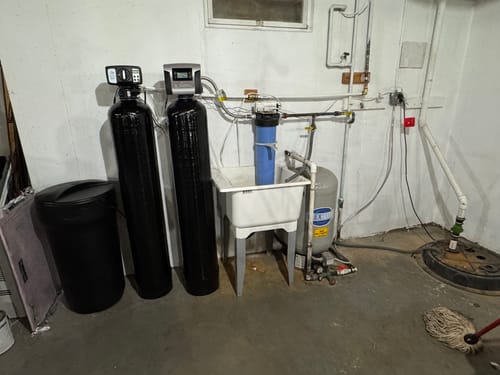
That larger tank requirement for ozone systems isn't just about backwash capacity—it also sets a hard ceiling on how much iron the system can realistically handle. Once iron climbs above 7 ppm, the ozone filter's tank simply runs out of room to capture oxidized particles before breakthrough occurs. You'll start seeing iron slip through untreated, and consistency disappears.
Their larger tanks accommodate iron loads up to 15 ppm, giving oxidized particles enough contact time and media space to get captured completely. We're not talking about a minor performance edge—we're talking about the difference between reliable removal and a system that's perpetually overwhelmed. Matching tank size to your actual iron concentration isn't optional; it's the whole game.
Sizing an Ozone Iron Filter for High Iron Well Water
So you've confirmed iron levels above 7 ppm—now what? Here's where sizing gets critical. Standard air injection oxidation filters tap out at this threshold, which means we're moving into ozone territory.
But ozone filters aren't a drop-in swap. They demand a higher backwash rate—between 100 and 200 gallons per cycle—so tank sizing must account for that volume. Undersizing here means incomplete iron flushing, and your system fails prematurely.
There's another layer worth knowing: ozone alone can't handle iron above 7 ppm. We'd recommend pairing the ozone filter with a whole-home chlorination system for maximum iron reduction. Think of ozone as your primary workhorse and chlorination as the cleanup crew. Together, they cover what neither handles alone.
AIO Iron Filter Sizing: Flow Rate and Iron Level
How do you know which AIO system actually fits your home? It comes down to two variables: your water's iron concentration and your household's flow rate.
If your iron levels stay below 2 ppm and your flow rate doesn't exceed 5 gallons per minute, a 1.0 cubic foot system handles the job cleanly. Push that iron above 2 ppm or your flow into the 5-7 gallon-per-minute range, and you'll need to step up to a 1.5 cubic foot unit.
Larger households running 6-8 occupants with flow rates up to 10 gallons per minute require a 2.0 cubic foot system. But once iron climbs above 7 ppm, an AIO system reaches its ceiling—at that point, whole-home chlorination becomes the smarter solution.
Ozone vs. AIO Iron Filter Size: Head-to-Head Comparison
Both systems pull from the same sizing range—1.0 to 2.0 cubic feet—but that's where the similarity stops. Ozone systems size purely on flow rate, ignoring iron concentration entirely. AIO systems account for both. That distinction matters more than most people realize.
Think about it this way: two homes with identical flow rates but different iron levels would get the same ozone system, yet completely different AIO configurations. AIO sizing examines the full picture of your water chemistry.
There's also pH to examine. Ozone needs a minimum of 6.8 to work effectively, while AIO operates down to 6.0. If your water runs acidic, that gap closes the door on ozone altogether—and opens it wider for AIO.
Frequently Asked Questions
How Big of an Iron Filter Do I Need?
The size you'll need depends on your well's flow rate and household size. We recommend matching GPM to cubic footage—5 GPM needs 1.0 cu ft, while larger families or higher iron levels require bigger systems.
Will a 5 Micron Filter Remove Iron?
A 5-micron filter can catch some iron particles, but it won't remove dissolved ferrous iron — the most common type. You'll need oxidation first, then filtration, to tackle iron effectively.
What Is the Best Iron Filter for an Irrigation System?
For irrigation systems, we'd recommend a spin-down sediment filter or sand media filter. They'll effectively remove iron particulates without clogging quickly, reducing pressure, or introducing chemicals that could damage your plants.
Can Bacteria Pass Through a 0.1 Micron Filter?
While most bacteria can't pass through a 0.1 micron filter, smaller species like mycoplasma can sneak through. That's why we'd recommend pairing filtration with UV light or chlorination for complete protection.


