


![SoftPro™ Chlorine+ Carbon Whole House Water Filter to Remove PFAS, Chlorine, Chloramine & Pesticides [City Water Filters Series]](http://softprowatersystems.com/cdn/shop/files/SoftPro_Whole_House_Carbon_Filter_with_Spin_Down_Water_Filter.webp?v=1783547361&width=140)


 855-683-8488


pH and Iron Interaction in Well Water: Why Low pH Slows Iron Oxidation

When your well water's pH drops below 6.5, iron oxidation fundamentally/basically/effectively stalls. Hydroxide ions become too scarce to convert ferrous iron into its insoluble ferric form, so dissolved iron just lingers in the water instead of precipitating out. Chemical oxidation slows dramatically, iron-removing bacteria shut down entirely, and your filtration system can't keep up. Understanding exactly why this happens — and where that critical pH threshold comes from — changes how you approach the whole problem.
Key Takeaways
- Below pH 6.5, hydroxide ion concentrations drop too low to facilitate efficient conversion of ferrous iron to ferric iron.
- Acidic conditions dramatically increase ferric iron's solubility, suppressing precipitation and keeping dissolved iron suspended in water.
- Sulfate complexes formed in acidic water shift the Fe²⁺/Fe³⁺ redox potential, thermodynamically favoring ferrous iron stability.
- Chemical oxidation kinetics slow considerably under acidic conditions, allowing dissolved ferrous iron to persist longer in well water.
- Iron-oxidizing bacteria, nature's built-in filtration system, cannot function below pH 6.5, leaving biological iron removal completely inactive.
What pH Does to Iron Solubility in Well Water

When the pH of well water drops, iron behaves very differently than it does at neutral or alkaline conditions. At low pH, hydroxide ions become scarce, and that scarcity keeps both ferrous iron (Fe²⁺) and ferric iron (Fe³⁺) dissolved rather than precipitating out. Ferrous iron's solubility increases dramatically, while ferric iron stays in solution by forming complexes with sulfate and hydroxide ions.
Here's what makes this especially interesting: lower pH also shifts the Fe²⁺/Fe³⁺ reduction potential in a more negative direction, thermodynamically stabilizing ferrous iron. It becomes harder to oxidize. So we're not just dealing with more dissolved iron — we're dealing with iron that actively resists the chemical transformation we'd need to remove it effectively.
Why Low pH Keeps Ferrous Iron Dissolved Longer
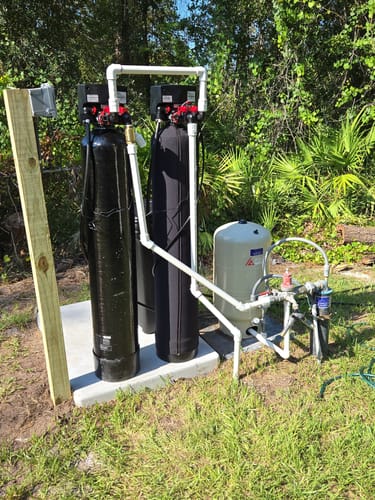
So why does ferrous iron linger so stubbornly in acidic well water? Several converging mechanisms explain it.
At low pH, ferric iron's solubility increases dramatically, meaning oxidized iron stays dissolved rather than precipitating out. Simultaneously, sulfate complexes shift the Fe²⁺/Fe³⁺ redox potential more negative, thermodynamically stabilizing ferrous iron.
| Factor | Low pH Effect | Outcome |
|---|---|---|
| Ferric solubility | Greatly increased | Precipitation suppressed |
| Redox potential | More electronegative | Fe²⁺ thermodynamically favored |
| Microbial oxidation | Bioenergetically constrained | Biological conversion slowed |
Chemical oxidation kinetics also slow considerably under acidic conditions, and acidophilic iron-oxidizing microorganisms face bioenergetic limitations that restrict coupling iron oxidation to alternative electron acceptors. Together, these forces create an environment where ferrous iron resists conversion — staying dissolved, mobile, and problematic.
Why pH 6.5 Is the Turning Point for Iron Oxidation
The pH 6.5 threshold isn't arbitrary — it marks a genuine chemical inflection point where iron oxidation kinetics shift from sluggish to rapid. Below this level, hydroxide ion concentrations drop too low to facilitate efficient ferrous-to-ferric conversion, so iron stays dissolved and mobile.
pH 6.5 isn't arbitrary — it's the chemical turning point where iron shifts from dissolved and mobile to reactive and removable.
Above it, oxidation accelerates sharply, ferric iron precipitates form quickly, and that familiar rust-colored sediment appears.
Here's why this matters for treatment: water sitting below pH 6.5 behaves fundamentally differently than water just above it. The solubility curves, reaction rates, and precipitation dynamics all change dramatically across this narrow window.
We can't apply a one-size-fits-all iron removal strategy without first knowing which side of that threshold we're working with. That single measurement shapes everything downstream.
Why Acidic Well Water Shuts Down Natural Iron-Removing Bacteria
Acidic well water doesn't just slow down iron chemistry — it also shuts down the microscopic workforce that handles iron removal naturally. Iron-oxidizing bacteria are nature's built-in filtration system, converting dissolved ferrous iron into insoluble ferric hydroxide that we can actually filter out.
But here's the problem: these bacteria need a pH between 6.5 and 8.5 to survive and function. Drop below that threshold, and their activity collapses entirely.
When we lose that biological iron removal process, dissolved iron accumulates unchecked. The result? Clogged pipes, stained fixtures, and water quality that keeps degrading. Understanding this biological dependency helps us see why correcting pH isn't just a chemistry fix — it's the key to restoring the entire natural iron management system in our wells.
How to Raise Well Water pH for Better Iron Removal
Once we comprehend why pH matters so much for iron removal, the next step is actually doing something about it. Raising acidic well water from below 6.5 into the ideal 6.5–8.5 range transforms how iron behaves.
At that neutral-to-alkaline level, dissolved ferrous iron oxidizes rapidly, converting to insoluble ferric iron that precipitates out as iron hydroxides—making filtration dramatically more effective.
We've got several solid options for achieving this. Calcite or limestone beds neutralize acidity passively as water flows through them. Soda ash offers a more forceful chemical correction. For precision control, chemical feed pumps deliver consistent pH adjustment before water ever reaches the filter.
Each approach targets the same outcome: eliminating red water, staining, and iron bacteria by creating conditions where iron simply can't stay dissolved.
Frequently Asked Questions
What Cancels Out Iron Absorption?
Tannins, calcium, phosphates, and phytic acid all cancel out iron absorption. We can also add high pH levels to that list — they'll oxidize iron quickly, making it far less bioavailable for our bodies to use.
Why Does Iron Oxidize in Water?
When iron meets dissolved oxygen in water, it loses electrons and converts from soluble ferrous iron (Fe2+) to insoluble ferric iron (Fe3+). We call this oxidation, and it's what creates those reddish-brown stains.
What Are the Symptoms of Too Much Iron in Well Water?
We'll notice reddish-brown stains on fixtures, a metallic taste in beverages, clogged appliances, and slimy bacterial deposits in pipes. If iron exceeds 0.3 mg/L, we've surpassed the EPA's recommended limit.


