


![SoftPro™ Chlorine+ Carbon Whole House Water Filter to Remove PFAS, Chlorine, Chloramine & Pesticides [City Water Filters Series]](http://softprowatersystems.com/cdn/shop/files/SoftPro_Whole_House_Carbon_Filter_with_Spin_Down_Water_Filter.webp?v=1783547361&width=140)


 855-683-8488


SoftPro Iron Master AIO Review: Real Cleveland Homeowner Results

Hi, I'm Martinez S.. I live in Cleveland.
Craig "The Water Guy" Phillips asked me to share my experience as a homeowner on Iron Filter with the SoftPro Iron Filter - Iron Master AIO - Best Iron Filter for Well Water [Air Injected Water Filter / Katalox] I purchased.
This is how my adventures played out. I hope this helps you in your decision.
The Iron Water Nightmare That Started It All
Did you know that nearly 75% of American homes with well water deal with iron contamination?
I certainly didn't when I first moved to my Cleveland home three years ago. What I did know was that something was seriously wrong with my water.
Every morning felt like a battle against rusty stains.
My white shirts turned orange in the wash, no matter what detergent I used. The toilet bowls developed these stubborn rust rings that required daily scrubbing. Worst of all, my coffee tasted metallic – and as someone who works from home, that morning cup is sacred.
The breaking point came last winter when my dishwasher started leaving orange spots on every glass and plate. I'd run the cycle twice, thinking it was a detergent issue, but those stains kept appearing. My wife finally said, "We need to fix this water situation before it ruins everything we own."
That's when I started researching iron levels in well water.
I discovered that iron concentrations above 0.3 parts per million cause noticeable staining and taste issues. My water tested at 4.2 PPM – more than thirteen times the recommended level. No wonder everything was turning orange.
The iron in well water comes from underground minerals dissolving into the water supply as it moves through iron-rich soil and rock formations. In Northeast Ohio, this is incredibly common due to our geological makeup. What I learned was that there are actually two types of iron in water: ferrous (dissolved) and ferric (oxidized), and my water had both.
My Research Journey Into Iron Filtration Systems
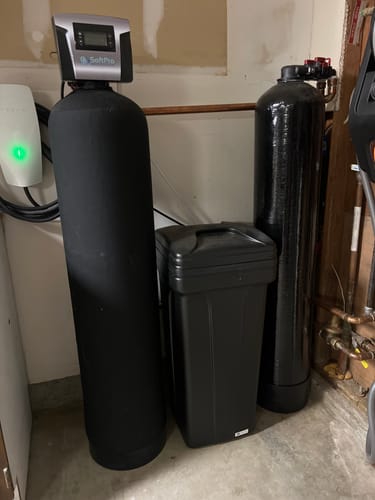
Once I understood the scope of my iron problem, I dove deep into filtration solutions.
The options felt overwhelming at first. There were basic sediment filters, which I quickly learned wouldn't touch dissolved iron. Chemical injection systems seemed too complex for a DIY homeowner like me. Salt-based water softeners could handle some iron, but multiple sources warned they weren't designed for high iron levels like mine.
Then I discovered air injection oxidation systems.
The concept made perfect sense: inject air into the water to convert dissolved ferrous iron into oxidized ferric iron, then filter out the rust particles. It's essentially speeding up the natural oxidation process that was already happening in my pipes and fixtures.
I spent weeks comparing different brands and technologies. Some systems used separate air compressors, which seemed like more potential maintenance headaches. Others required chemical additives that I wanted to avoid. The SoftPro Iron Master AIO caught my attention because it combined air injection and filtration in a single unit – no external compressors, no chemicals, just air and a specialized Katalox filtration media.
What sealed the decision was learning about the Katalox media itself.
Unlike traditional greensand filters that require potassium permanganate regeneration, Katalox is a catalytic media that regenerates with just air and water backwashing. This meant lower ongoing costs and fewer chemicals in my system.
The sizing calculations were crucial too. With a household of four and iron levels at 4.2 PPM, I needed a system that could handle both our flow rate demands and iron removal capacity. The Iron Master AIO handles up to 7 GPM flow rate and iron levels up to 15 PPM, giving me plenty of headroom for our needs.
Unboxing and First Impressions
The Iron Master AIO arrived on a freight truck in February, which made me nervous about cold-weather shipping. Fortunately, everything was well-packaged and arrived in perfect condition.
The main unit is substantial – about 54 inches tall and weighing roughly 150 pounds when filled with media. The fiberglass tank feels solid and professional-grade, not like some of the plastic units I'd seen from other manufacturers.
Inside the box, I found the pre-loaded media tank, the digital control head, installation hardware, and a detailed manual. SoftPro pre-loads the Katalox media, which saved me the messy job of handling filtration media myself – a nice touch that some competitors don't offer.
The digital control head looked more sophisticated than I expected.
Instead of a basic timer, it featured a Fleck 7000SXT valve with actual programming options for backwash frequency, duration, and flow rates. The display was clear and intuitive, which gave me confidence that I could handle the setup and ongoing adjustments.
One thing that impressed me immediately was the bypass valve assembly. It's a three-valve setup that allows you to completely isolate the system for maintenance while keeping water flowing to the house. Having dealt with other home improvement projects, I appreciated this level of thoughtful design.
Installation Experience and Setup Challenges

I'll be honest – I debated hiring a plumber for this installation.
The system requires cutting into your main water line, installing the bypass assembly, and connecting drain lines for the backwash cycle. After watching several installation videos and studying the manual thoroughly, I decided to tackle it myself with help from my brother-in-law who has plumbing experience.
The installation took us about six hours on a Saturday morning, including a trip to the hardware store for additional fittings. The most challenging part was positioning the heavy unit in my utility room and ensuring proper clearances for the control head and drain connections.
We installed it right after my pressure tank, before the water line splits to supply the house. This positioning ensures all household water gets treated while protecting the pressure tank from any iron buildup. The unit requires 110V power for the control head and needs a drain connection for backwash cycles.
The drain connection was trickier than expected.
The backwash produces significant flow – about 7 GPM during regeneration – so it needs a proper drain, not just a floor drain that might overflow. We connected it to my utility sink with an air gap to prevent any backflow issues.
Initial startup involved programming the control head with my specific water conditions and usage patterns. The manual provides clear guidance on setting backwash frequency based on iron levels and water usage. For my 4.2 PPM iron and family of four, I programmed it for backwash every three days initially, planning to adjust based on actual performance.
The first regeneration cycle was fascinating to watch.
The system automatically drew air into the tank, mixed it with incoming water, then backwashed the oxidized iron particles down the drain. The entire process took about 20 minutes and was surprisingly quiet – just the sound of water flowing, no loud mechanical noises.
Real-World Performance and Water Quality Results
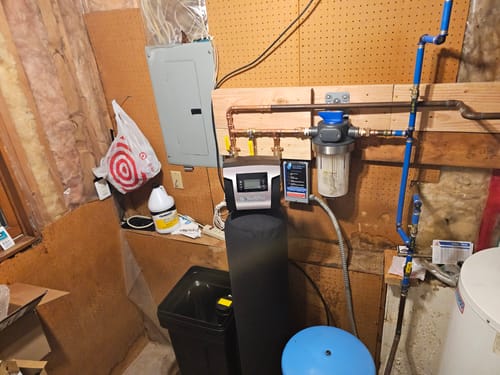
The difference was noticeable within 24 hours of startup.
That first morning cup of coffee tasted clean – no metallic aftertaste that I'd grown accustomed to over three years. My wife noticed it immediately too, commenting that the water just tasted "right" for the first time since we'd moved in.
I tested the water quality after one week of operation using both home test strips and a more accurate digital TDS meter. The iron levels dropped from 4.2 PPM to less than 0.1 PPM – well below the 0.3 PPM threshold where staining and taste issues occur. Even better, the improvement was consistent across multiple tests over several weeks.
The real proof came in our daily household activities.
Laundry stopped coming out with orange tints, even white loads that used to be problematic. The dishwasher began producing spot-free glassware again. Most satisfying was watching the existing rust stains in our toilets and sinks gradually fade away as the iron-free water slowly cleaned the residual buildup.
After three months of operation, I had the water professionally tested by a local lab to verify my home testing results. The comprehensive analysis confirmed iron levels at 0.08 PPM, along with improvements in overall water clarity and taste. The lab technician mentioned that these were excellent results for a well water system with our original iron concentrations.
Flow rate performance has been outstanding too.
Even during peak usage times – morning showers while the dishwasher runs – I haven't noticed any pressure drops or flow restrictions. The system's 7 GPM capacity handles our household demands with room to spare.
One unexpected benefit was the improvement in our water heater efficiency. Our plumber mentioned during a routine service call that the heat exchanger looked cleaner than expected for a three-year-old unit. Apparently, removing iron prevents the mineral buildup that reduces heating efficiency over time.
Operating Costs and Maintenance Reality
Let me break down the real costs of owning this system, because this was a major factor in my decision.
The Iron Master AIO doesn't require salt, chemicals, or replacement cartridges – just periodic backwashing with your own well water. This keeps ongoing costs minimal compared to other iron removal methods.
Electricity usage is negligible.
The control head only draws power during regeneration cycles, about 20 minutes every three days in my case. My utility bill hasn't shown any noticeable increase from the system operation.
Water consumption for backwashing is more significant.
Each regeneration cycle uses approximately 140 gallons for the complete backwash and rinse sequence. At three cycles per week, that's about 420 gallons monthly – roughly equivalent to five extra loads of laundry. Since I'm on a well, this doesn't directly impact my utility costs, but it's worth considering for capacity planning.
I did adjust the backwash frequency after six months of operation.
By monitoring water quality and system performance, I found I could extend the interval to every four days without any degradation in iron removal. This reduced water consumption to about 315 gallons monthly while maintaining excellent results.
The only maintenance requirement so far has been occasional cleaning of the control head display and checking the bypass valve operation. The Katalox media is rated for 10-15 years of service life, so replacement costs are far in the future.
Compared to my previous expenses for bottled water, extra detergent, and appliance cleaning products, the system has already started paying for itself. I estimate we're saving about $40 monthly in various iron-related costs, not counting the avoided expense of appliance repairs or premature replacement.
Long-Term Ownership Experience and Observations
Eight months into ownership, I can confidently say this system has exceeded my expectations.
The initial iron removal performance has remained consistent – no degradation or breakthrough that sometimes occurs with other filtration technologies. Water quality tests still show iron levels below 0.1 PPM.
The control head has been completely reliable.
It automatically manages regeneration cycles based on my programmed settings, and I've never had to intervene or troubleshoot any issues. The digital display provides clear status information, including days until next regeneration and current system mode.
I've made a few minor adjustments to optimize performance.
During summer months when our water usage increases with lawn watering and pool filling, I shortened the regeneration interval slightly to maintain peak performance. The system's programmability makes these adjustments simple.
One thing I've learned is the importance of protecting the system from power outages.
We lost power for six hours during a storm, and when electricity returned, the control head had reset to default settings. I quickly reprogrammed it, but now I'm considering a small UPS backup to prevent this minor inconvenience.
The system's performance during different seasons has been interesting to observe. Winter months with lower water usage allow longer intervals between regenerations, while summer demands more frequent cycling. The automatic adjustment capability handles these variations seamlessly.
Family and friends have noticed the improvement too.
Visitors often comment on how good our water tastes, especially compared to their city-treated water. My brother-in-law, who helped with installation, is now planning to install a similar system at his house after seeing our results.
If I had to identify any minor drawbacks, it would be the space requirements. The 54-inch height and 12-inch diameter footprint might be challenging in smaller utility rooms. Also, the backwash noise, while not excessive, is noticeable if your utility area is near living spaces.
Final Assessment and Recommendation
After eight months of daily use, I can honestly say the SoftPro Iron Master AIO has transformed our water quality and eliminated the iron problems that plagued our household.
The system delivers consistent performance, requires minimal maintenance, and operates efficiently without ongoing chemical or consumable costs.
Would I purchase this system again?
Absolutely. The combination of effective iron removal, reliable operation, and low maintenance requirements makes it an excellent long-term solution for well water iron problems.
Who should consider this system?
Homeowners with iron levels between 1-10 PPM who want a chemical-free solution that doesn't require ongoing consumable purchases. The air injection technology works particularly well for dissolved iron issues common in well water supplies.
Who might want alternatives?
If you have extremely high iron levels (above 15 PPM) or sulfur odor issues, you might need a more specialized system. Also, homes with very limited utility space might struggle with the unit's dimensions.
The investment has proven worthwhile not just for water quality, but for protecting our appliances, reducing household cleaning challenges, and improving our overall quality of life. Clean, iron-free water is something you don't fully appreciate until you've lived without it – and then experienced the difference a quality filtration system makes.
For Cleveland-area homeowners dealing with similar iron water issues, I'd strongly recommend considering the Iron Master AIO. The combination of proven air injection technology, reliable Fleck control systems, and SoftPro's thoughtful design details creates a solution that simply works day after day, year after year.


