


![SoftPro™ Chlorine+ Carbon Whole House Water Filter to Remove PFAS, Chlorine, Chloramine & Pesticides [City Water Filters Series]](http://softprowatersystems.com/cdn/shop/files/SoftPro_Whole_House_Carbon_Filter_with_Spin_Down_Water_Filter.webp?v=1783547361&width=140)


 855-683-8488


Well Water Chemistry Test Results That Determine Your Iron Filter Choice

Your well water test report gives you the exact numbers that determine which iron filter will actually work. We focus on six key parameters: iron levels, pH, hardness, manganese, sulfur, and bacteria. Iron above 0.3 ppm signals a treatment need, while pH below 7.0 means a standard iron filter won't perform without additional support. Each number narrows your options considerably, and understanding what they mean together points you toward the right solution.
Key Takeaways
- Iron levels above 0.3 ppm require treatment, with concentrations above 10 ppm demanding industrial-grade filtration systems.
- pH below 7.0 neutralizes iron filter effectiveness, requiring an acid neutralizer installed upstream of the filter.
- Manganese present alongside iron demands catalytic filter media specifically engineered to target both contaminants simultaneously.
- High water hardness requires a water softener paired with the iron filter to protect filter media.
- Bacteria, sulfur, and nitrates identified in test results require separate or additional treatment strategies beyond standard iron removal.
What the 6 Key Parameters on Your Iron Test Report Actually Mean

When you get your well water test results back, six numbers will ultimately determine which iron filter you need—and most homeowners don't know what half of them mean.
Here's what matters: iron levels above 0.3 ppm signal a treatment problem. pH below 7.0 means your iron filter won't work properly without an acid neutralizer first. Hardness, manganese, and sulfur each demand their own targeted solutions beyond standard iron removal. Bacteria requires a completely separate treatment strategy. Total dissolved solids give you a broad snapshot of everything dissolved in your water. If your well sits near farmland, nitrates become critical—the EPA caps them at 10 ppm. Understanding these six parameters together tells you exactly what system configuration you actually need.
How to Read Your Well Water Test Results and Spot the Problem Numbers
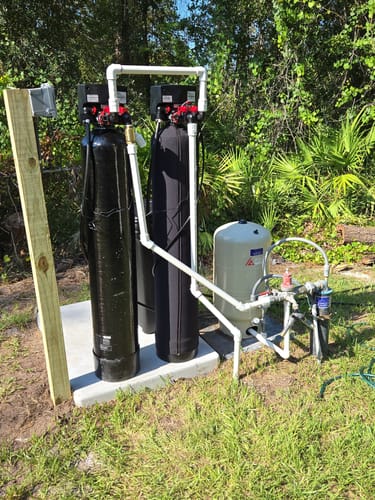
Your well water test results look like a spreadsheet of numbers at first glance—but once you know what to flag, the problems jump right off the page. Start with iron—is it ferrous (dissolved, invisible) or ferric (oxidized, visible)? Each demands a different treatment approach.
Next, check your pH. Anything below 7.0 can neutralize an iron filter's effectiveness before it even starts working. Then scan manganese, sulfur, and bacteria levels—these parameters directly shape which filtration system you'll actually need.
Don't overlook TDS and nitrates; they paint a fuller picture of your water's overall condition. One critical note: DIY test strips won't cut it here. Certified lab results give you the parts-per-million precision required to size equipment correctly and solve the right problem.
What Your Iron Level Tells You About Which Iron Filter You Need?
Four numbers on your water test report—0.3, 3, 6, and 10 ppm—essentially map out the entire iron filter decision tree for you. Below 0.3 ppm, you likely don't need dedicated filtration. From 0.3–2 ppm, light oxidation-based systems handle it. Between 3–6 ppm, you'll need a high-capacity iron-specific system. Above 10 ppm, only industrial-grade filters will keep up.
| Iron Level (ppm) | Contamination Severity | Recommended Filter Type |
|---|---|---|
| Below 0.3 | Negligible | No dedicated filter needed |
| 0.3–2 | Light | Oxidation-based filtration |
| 3–6 | Moderate | High-capacity iron-specific system |
| Above 10 | Severe | Industrial-grade high-flow filter |
How pH, Manganese, and Hardness Narrow Down Your Iron Filter Options?
If your pH falls below 7.0, your iron filter will underperform without an acid neutralizer upstream. Acidic water disrupts oxidation chemistry, so we fix the water's foundation first.
Manganese changes the equipment equation entirely. It demands catalytic media specifically engineered to handle both contaminants—standard iron filters simply won't cut it.
High hardness creates yet another layer. Calcium buildup degrades filter media over time, so we integrate a water softener to protect the system's long-term performance.
These three parameters don't just influence your filter choice—they determine your entire treatment sequence. Get them wrong, and even a correctly-sized iron filter will fail.
The Iron Filter Match: Pairing Test Results to the Right Treatment System
Every test result you've gathered now becomes a direct input into your treatment decision. Ferrous iron above 0.3 ppm signals you need oxidation-based filtration, and concentrations climbing past 2 ppm demand high-capacity systems built for heavier loads.
If your pH reads below 7.0, install an acid neutralizer first—acidic water will undermine even the best iron filter. When manganese shows up alongside iron, you'll need catalytic media specifically designed to tackle both contaminants simultaneously.
Hard water? Pair your iron filter with a softener so both systems reinforce each other. Think of your test results as a blueprint—each parameter eliminates certain options and confirms others. Work systematically through your numbers, and you'll arrive at a treatment combination that genuinely solves your water quality problem.
Frequently Asked Questions
What Is an Acceptable Iron Level in Well Water?
We'd recommend keeping iron levels below 0.3 mg/L—that's the EPA's threshold for avoiding staining and metallic taste. Anything above that requires some form of iron filtration to protect your water quality.
Who Makes the Best Iron Filter for Well Water?
Culligan, Pelican, and Aquasana make the best iron filters for well water. We'd also recommend systems using Fleck or Clack valves, as they're built for durability and handle heavy iron loads most effectively.
How to Get Rid of High Iron in Well Water?
To remove high iron from well water, we'll want to use oxidation-based filtration, like greensand filters or air injection systems. Pre-oxidation with chlorine or ozone converts dissolved iron into filterable solids for maximum removal efficiency.
How Do You Know if Your Well Water Is High in Iron?
We'll know our well water's high in iron if we notice red-brown staining, a metallic taste, or discolored water. We can confirm it by testing — levels above 0.3 mg/L indicate a problem.


