


![SoftPro™ Chlorine+ Carbon Whole House Water Filter to Remove PFAS, Chlorine, Chloramine & Pesticides [City Water Filters Series]](http://softprowatersystems.com/cdn/shop/files/SoftPro_Whole_House_Carbon_Filter_with_Spin_Down_Water_Filter.webp?v=1783547361&width=140)


 855-683-8488


Well Water Chemistry Testing: What a Full Pre-Filter Panel Should Include

Before we choose a single filter, we need to know exactly what we're dealing with. A full pre-filter panel should test for biological safety (total coliform and E. coli), chemical thresholds like nitrate and pH, and mineral load including hardness, iron, and manganese. Together, these markers paint a complete picture of our water's chemistry. Skip any category and we're treating blind. Stick with us and we'll show you how to build a panel that actually protects your home.
Key Takeaways
- A full pre-filter panel must test biological safety, including total coliform and E. coli, to confirm harmful bacteria are absent.
- Chemical thresholds like nitrate levels and pH must be measured to detect potential corrosion or contamination risks.
- Mineral load testing for hardness, iron, manganese, and sulfate reveals the complete chemical portrait of your well water.
- Location-specific tests for arsenic, VOCs, or nitrates should be added based on nearby farmland, industry, or geological factors.
- Certified lab tests deliver precise decimal-level results, making them far more reliable than DIY kits or free company-provided tests.
Why You Need a Baseline Test Before Choosing a Treatment System

Before choosing a water treatment system, we need to understand exactly what's in your well water—and that starts with a thorough baseline test. Think of it like a medical diagnosis before prescribing treatment—you wouldn't take medication without knowing what's wrong first.
Without this baseline, you're fundamentally guessing. That guess could cost you—either through an undersized system that fails to solve your problems or an oversized one that drains your wallet unnecessarily.
Free in-home tests and DIY kits only scratch the surface, leaving critical contaminants undetected. A full pre-filter panel gives us the complete picture: every mineral, contaminant, and parameter that shapes your water's unique chemistry. That's the foundation for making smart, targeted investments in treatment technology that actually works.
What Every Well Water Test Panel Should Include
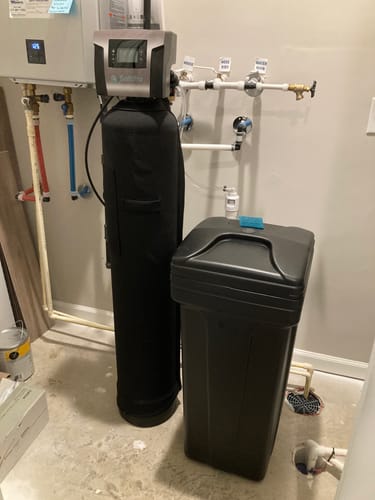
A solid test panel covers several key categories—each one telling a different part of your water's story.
We recommend testing for these three critical areas:
- Biological safety – Total coliform and E. coli confirm whether harmful bacteria are present.
- Chemical thresholds – Nitrate levels above 10 mg/L become dangerous, especially for infants, and pH reveals whether your water's quietly corroding your pipes and leaching lead.
- Mineral load – Hardness, iron, manganese, and sulfate won't necessarily make you sick, but they'll stain your fixtures, scale your appliances, and leave a metallic taste that makes you avoid drinking what you should.
Together, these markers give you a complete chemical portrait—not just snapshots. Without all three categories, you're making treatment decisions in the dark.
When to Add Nitrates, Arsenic, and VOCs to Your Panel
That core panel we just covered handles the universal risks—but your well's surroundings tell a second story that standard testing won't catch. Think of your well's location as a clue map.
Farmland or septic systems nearby? Add nitrates—they leach aggressively into groundwater and threaten infant health at surprisingly low concentrations. Sitting in a region with naturally occurring arsenic geology? It needs to be on your list, full stop. Living near industrial sites or gas stations? VOCs become non-negotiable; these compounds infiltrate groundwater quietly and carry serious long-term health consequences.
We're not testing everything—we're testing smart. Matching your panel to your well's specific environment transforms a generic screen into a genuine safety audit. That precision is what separates thorough water management from guesswork.
Certified Lab Test vs. DIY Kit: What Actually Works Pre-Filter
Once you've identified what to test for, the next question is who—or what—does the actual testing. Pre-filter, your water tells its rawest story, so testing accuracy matters enormously.
Here's how your three realistic options stack up:
- Certified lab tests deliver precise decimal-level results across a wide parameter range, costing $50–$200+, but they're your gold standard for treatment decisions.
- DIY hardware store kits offer quick, inexpensive screening with general contaminant ranges—useful for a first pass, but too imprecise to guide actual filtration choices.
- Free company-provided tests use basic kits that can skew results toward selling you equipment—independent testing protects your judgment.
We'd skip the shortcuts here. Proper sample collection—flushing lines, sterile containers, prompt delivery—also determines whether any test, lab or DIY, actually means something.
How to Pull a Water Sample That Shows What's Actually in Your Well
Most people ruin their well water sample before it even reaches the lab—and they don't realize it until the results come back misleading.
Here's what actually matters: skip the outdoor spigot. That tap has a backflow preventer and sediment that distorts your baseline. Instead, find a cold-water indoor tap without an aerator, run it for two full minutes to purge standing pipe water, then collect directly into the lab-provided container. Don't touch the inside of the cap. Don't pre-rinse the bottle.
Temperature matters too—keep samples cold and ship same-day. We've seen accurate pre-filter chemistry get completely masked by improper collection. The sample isn't just water—it's evidence. Treat it like one.
Frequently Asked Questions
What Is a Full Panel Water Test?
A full panel water test examines your well water's complete chemical makeup—testing for bacteria, minerals, metals, and organic compounds—giving us a detailed picture of what's actually flowing through your pipes.
What Are the 5 Parameters of Water Quality Testing We Study?
We study five water quality parameters: physical properties, chemical characteristics, microbiological content, radiological presence, and aesthetic qualities. Together, they'll give us a complete picture of what's actually flowing through your well system.
What Are the Most Important Things to Test for in Well Water?
We recommend testing for total coliform bacteria, nitrates, total dissolved solids, and pH annually. We'd also contact our local health department—they'll identify location-specific contaminants we might've otherwise missed entirely.
Is It Safe to Shower in Water That Has Coliform Bacteria?
Showering in coliform-contaminated water isn't ideal, but it's generally low-risk for healthy adults. However, if you're immunocompromised, elderly, or have infants at home, we'd strongly recommend treating the water first.


