


![SoftPro™ Chlorine+ Carbon Whole House Water Filter to Remove PFAS, Chlorine, Chloramine & Pesticides [City Water Filters Series]](http://softprowatersystems.com/cdn/shop/files/SoftPro_Whole_House_Carbon_Filter_with_Spin_Down_Water_Filter.webp?v=1783547361&width=140)


 855-683-8488


Well Water Combined Test: What Hardness, Alkalinity, and Iron Tell You Together

When you test well water for hardness, alkalinity, and iron together, you stop chasing symptoms and start seeing the full picture of what your water is actually doing. Each parameter tells part of the story, but combined, they reveal why your pipes corrode, your fixtures stain, and your equipment fails. They expose root causes no single test can uncover, and they point directly toward the right treatment solution. Stick with us and we'll show you exactly how to use these results.
Key Takeaways
- Hardness, alkalinity, and iron interact chemically, so testing all three together reveals water problems that no single test can identify alone.
- Hardness measures calcium and magnesium scaling potential, alkalinity measures pH buffering capacity, and iron measures staining and corrosion risk.
- High alkalinity stabilizes pH, directly influencing how easily iron stays dissolved and how readily hardness minerals precipitate as scale.
- Combined test results reveal relationships: high hardness with high iron accelerates scaling, while low alkalinity with any iron destabilizes pH.
- Knowing all three values together allows you to select and properly size the correct water treatment system for your well.
Why a Combined Test Beats Testing Each One Separately

When it comes to well water, testing hardness, alkalinity, and iron separately is like diagnosing a car problem by checking only the engine, then only the transmission, then only the brakes — you'll miss how they interact. Together, these three parameters reveal something none of them can show alone.
Hardness and alkalinity jointly determine whether your water forms scale or corrodes pipes — and that dynamic directly affects how well iron removal works. Testing them in combination exposes the root causes behind staining, off-tastes, and equipment failures that isolated tests simply can't explain.
More importantly, understanding how all three interact lets us select and properly size the right treatment system — whether that's softening, pH adjustment, or iron filtration — instead of guessing with incomplete data.
What Hardness, Alkalinity, and Iron Each Measure
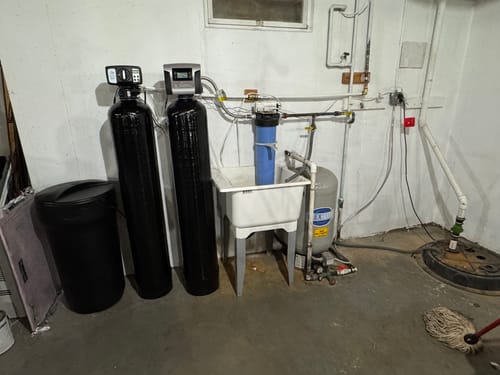
Before we can appreciate how these three parameters work together, it helps to understand what each one is actually telling us about our water.
To truly understand how water chemistry works, we must first learn what each parameter is actually measuring.
- Hardness measures dissolved calcium and magnesium ions, which cause scaling and weaken soap's effectiveness.
- Alkalinity measures your water's ability to resist pH changes, reflecting its acid-neutralizing capacity.
- Iron measures dissolved ferrous or ferric iron concentrations, which trigger staining, off-tastes, and potential health concerns.
Here's what makes this trio especially interesting: hardness and alkalinity aren't completely independent. Carbonate hardness directly equals alkalinity, while noncarbonate hardness stands apart. That relationship matters when we're selecting treatment systems. Together, these three parameters paint a complete picture of your water's chemistry—one that no single test can deliver alone.
How Hardness, Alkalinity, and Iron Affect Each Other
Now that we comprehend what each parameter measures, let's look at how they push and pull on each other—because understanding these interactions is what distinguishes a smart treatment decision from an expensive mistake.
High alkalinity buffers pH, which directly affects iron solubility and hardness mineral precipitation. These aren't isolated readings—they're a system.
| Interaction | What It Means |
|---|---|
| High hardness + high alkalinity | Scale forms aggressively in pipes and heaters |
| High iron + low alkalinity | pH swings accelerate corrosion |
| High alkalinity + low hardness | Softening becomes less effective |
| High iron + high hardness | Filters clog faster; dual treatment required |
| Balanced all three | Stable, treatable water chemistry |
Comprehending these relationships helps you sequence treatment correctly—softening before iron removal, for example, protects your equipment and your investment.
How to Read Your Combined Test Results
Once your test results are in hand, reading them isn't about analyzing each number in isolation—it's about seeing how hardness, alkalinity, and iron interact as a system. Each value shifts the meaning of the others.
Your test results don't speak in isolated numbers—they speak in relationships.
Here's what to watch for:
- High hardness + high iron: Scale buildup accelerates, and iron removal systems work harder
- Low alkalinity + any iron: pH instability undermines treatment efficiency, leaving iron removal incomplete
- High alkalinity + moderate hardness: Your system can buffer pH swings, creating favorable conditions for iron removal
We look at these combinations because the right treatment depends on the full picture. Iron above 0.3 ppm always demands action—but how you treat it depends entirely on what hardness and alkalinity reveal alongside it.
Which Treatment System Do Your Results Point To?
Reading your results as a system—not as isolated numbers—points you directly toward the treatment approach your water actually needs.
High hardness with low alkalinity? You're looking at a water softener.
High iron paired with low pH calls for an iron filter combined with an acid neutralizer.
Moderate hardness and alkalinity with elevated iron typically requires an oxidizing filter to pull that iron out effectively.
If everything reads low—hardness, alkalinity, and iron—your water's soft but corrosive, and a calcite-based neutralizer will raise both pH and alkalinity.
The most demanding scenario is when all three are high simultaneously, which means you'll need a multi-stage system covering softening, iron filtration, and pH adjustment.
Each combination tells a specific story, and your treatment system should answer it precisely.
Frequently Asked Questions
What Is Considered High Iron in Well Water?
We consider iron above 0.3 mg/L noticeable, above 3 mg/L a health concern, and above 10 mg/L a serious problem. Even at low levels, it'll stain fixtures and affect taste.
How to Interpret Water Hardness Test Results?
We interpret hardness results by comparing your mg/L reading: under 60 means soft, 60–120 is medium, and anything over 120 indicates hard water that'll likely cause scale buildup and soap inefficiency.
Does Hardness Affect Alkalinity?
Yes, hardness often influences alkalinity because the minerals causing hardness—calcium and magnesium—also contribute to alkalinity. However, they're not always perfectly linked, since bicarbonates and carbonates can raise alkalinity independently of your water's hardness level.
How to Tell if You Have Iron Bacteria in Well Water?
Look for reddish-brown slime in your pipes, stained laundry, or a foul taste and odor in your water. We'd recommend confirming with a BART test, which specifically detects iron bacteria presence.


