


![SoftPro™ Chlorine+ Carbon Whole House Water Filter to Remove PFAS, Chlorine, Chloramine & Pesticides [City Water Filters Series]](http://softprowatersystems.com/cdn/shop/files/SoftPro_Whole_House_Carbon_Filter_with_Spin_Down_Water_Filter.webp?v=1783547361&width=140)


 855-683-8488


Well Water Iron at 10 PPM: What an Iron Filter Needs to Handle

Ten PPM of iron doesn't just stress a standard filter—it destroys one. Most filters are built for up to 5 PPM, so doubling that load exhausts the media faster than backwashing can recover it. You'll see pressure drops, weak flow, and constant maintenance. Handling 10 PPM requires pre-oxidation, the right media volume, proper backwash capacity, and a pH in a specific range. Get any piece wrong, and the whole system fails—but get it right, and it works beautifully.
Key Takeaways
- At 10 PPM iron, standard filters exhaust media faster than backwashing can restore them, causing pressure drops and constant maintenance issues.
- Pre-oxidation is required to convert dissolved ferrous iron into filterable ferric iron before it reaches the filter media.
- A minimum of 1.5 cubic feet of Katalox Light or Pro-OX Lite media ensures adequate oxidation and particle capture capacity.
- Maintain pH between 6.8 and 8.0 using a neutralizer tank, as levels outside this range interfere with filtration efficiency.
- A backwash flow rate of 15–20 GPM is necessary to effectively flush trapped iron particles from saturated media.
Why 10 PPM Iron Overwhelms a Standard Filter

Most standard iron filters are built to handle up to 5 PPM of iron — so what happens when your well water clocks in at double that? The short answer: the system gets buried.
At 10 PPM, iron exhausts the filter media faster than backwashing can recover it. Pressure drops. Flow weakens. What's designed as a low-maintenance solution suddenly demands constant attention — more frequent backwashing, earlier media replacement, and ongoing monitoring.
It doesn't stop there. That excess iron starts scaling the tank walls and plumbing, quietly compounding the damage over time. A standard filter isn't engineered for this workload. It's not a capacity issue you can troubleshoot around — it's a fundamental mismatch between the problem and the tool.
How to Set Up Your Filter System When Iron Hits 10 PPM
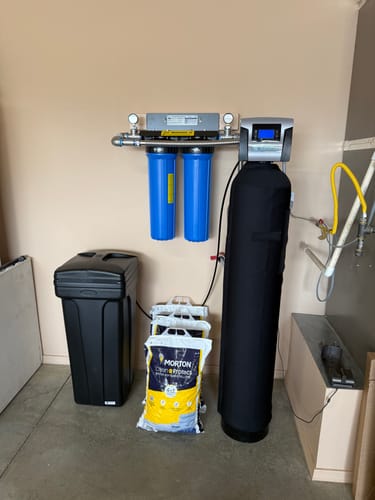
So if a standard filter can't keep up, what does the right setup actually look like?
When a standard filter falls short, the right setup requires more — starting before water even hits the tank.
Start with pre-oxidation. A chemical feed pump or air injection system converts dissolved ferrous iron into filterable ferric particles before water even reaches the tank. Without that step, iron slips right through.
Next, you'll need a filter tank loaded with at least 1.5 cubic feet of Pro-OX Lite media and a flow rate of 12 GPM minimum to handle peak demand.
Add a neutralizer tank to keep pH between 6.8 and 8.0 — that range is where iron removal actually performs.
Finally, program backwash cycles of 10 to 15 minutes to flush trapped iron and keep the media working efficiently.
How to Size an Iron Filter for 10 PPM Iron Levels
Sizing an iron filter for 10 PPM isn't guesswork — every component needs to match the load your water is actually putting on the system. Get this wrong, and you're just pushing iron-laden water through an overwhelmed filter.
Here's what we need to nail down:
- Flow rate: Minimum 12–15 GPM keeps the system from choking under high iron demand
- Media volume: At least 1.5 cubic feet of Katalox Light handles proper oxidation and capture
- Pretreatment: Air injection or chemical oxidation converts ferrous iron into filterable ferric form
- Backwash capacity: 15–20 GPM flushes trapped particles completely during regeneration
- Pressure monitoring: Tracks media saturation before iron breaks through
Every spec here connects — undersize one element, and the whole system underperforms.
Does Your Well Pump Flow Rate Support Proper Backwashing?
Getting the filter sizing right is only half the battle — none of those specs matter if your well pump can't actually deliver the flow needed to backwash the system clean.
Here's the threshold that changes everything: 6 GPM. Drop below it, and your iron filter simply can't flush accumulated iron from the media bed effectively. Most residential wells produce between 6 and 12 GPM, which clears that bar comfortably.
But if your well delivers less, don't panic — you've got real options. A smaller filter tank, a storage/pressure tank setup, or parallel filters can all solve the problem.
Before purchasing anything, measure your actual pump flow rate. That single number determines whether your filter cleans itself properly or quietly fails over time.
pH and Flow Rate Tests to Run Before Buying an Iron Filter
Before you spend a dollar on an iron filter, two quick field tests will tell you more than any spec sheet: pH and flow rate.
Two field tests beat any spec sheet. Check pH and flow rate before you spend a dollar on an iron filter.
We've seen systems fail simply because nobody checked these numbers first.
- pH below 6.5 means oxidation-based filters struggle; you'll need aeration or chemical injection upstream
- pH above 8.0 can indicate bicarbonate interference that clogs media beds faster
- Flow rate under 5 GPM disqualifies most backwashing systems entirely
- Measure flow rate at peak demand, not idle conditions
- Test pH at the tap, not just the pressure tank
These two data points expose compatibility problems before you're committed. A $1,200 filter installed into the wrong conditions becomes an expensive decoration. Know your numbers first.
Frequently Asked Questions
What Is the Acceptable Iron Level in Well Water in Ppm?
We consider 0.3 mg/L (ppm) the EPA's acceptable iron level in well water. Exceed that threshold, and you're facing stained fixtures, discolored laundry, and a system that's quietly working against you.
What Is the Best Iron Filter for Removing Iron From Well Water?
We recommend a Pro-OX Lite media filter with at least 1 cubic foot of media, paired with an air injection pre-oxidation system, water softener, and acid neutralizer to effectively tackle high iron levels.
What Are Common Problems With Iron Filters?
We've seen iron filters struggle with insufficient backwash flow, improper sizing, neglected maintenance, pH imbalances, and iron bacteria clogging media—each problem quietly undermining your system's effectiveness until you're left with iron-laden water again.
What Is the Best Way to Filter Iron Out of Well Water?
We recommend using a manganese dioxide media filter, like Pro-OX Lite, to effectively remove iron from well water. It'll oxidize and trap iron particles while backwashing regularly keeps the media clean and flowing efficiently.


