


![SoftPro™ Chlorine+ Carbon Whole House Water Filter to Remove PFAS, Chlorine, Chloramine & Pesticides [City Water Filters Series]](http://softprowatersystems.com/cdn/shop/files/SoftPro_Whole_House_Carbon_Filter_with_Spin_Down_Water_Filter.webp?v=1783547361&width=140)


 855-683-8488


When a Cartridge Iron Filter Is Enough and When You Need a Backwashable System

If your water tests at up to 20 ppm iron, 10 ppm manganese, and 5 ppm sulfur, a cartridge filter can handle it. Push past those numbers, and you're looking at constant clogging, iron scaling, and premature failure. A backwashable system manages up to 30 ppm iron and cleans itself automatically, so you're never chasing the problem. The difference between these two systems goes deeper than most people realize.
Key Takeaways
- Cartridge iron filters work well for water with up to 20 ppm iron, 10 ppm manganese, and 5 ppm hydrogen sulfide.
- Backwashable systems are necessary when iron exceeds 20 ppm, manganese exceeds 10 ppm, or hydrogen sulfide exceeds 5 ppm.
- Cartridge filters require replacement every 6–12 months and cannot self-clean, making them less sustainable long-term.
- Backwashable systems automatically flush accumulated contaminants every 4–14 days, preventing iron scaling without user intervention.
- Katalox-Light media in backwashable systems lasts 6–10 years, offering significantly better longevity than cartridge-based alternatives.
What Iron Levels Actually Require a Backwashable Filter?

Not all iron problems are created equal, and the treatment system you need comes down to how much iron, manganese, and sulfur are actually in your water. Cartridge iron filters handle up to 20 ppm iron, 10 ppm manganese, and 5 ppm sulfur — solid performance for moderate contamination.
Push beyond those thresholds, and you're in backwashable territory. These systems manage up to 30 ppm iron, 15 ppm manganese, and 10 ppm hydrogen sulfide.
Here's what most homeowners miss: the gap between those ranges isn't just a number — it's the difference between a filter that keeps up and one that gets overwhelmed fast. Test your water first. Knowing exactly what you're dealing with tells you which system you actually need, not just which one sounds sufficient.
What Cartridge Filters Can and Can't Remove
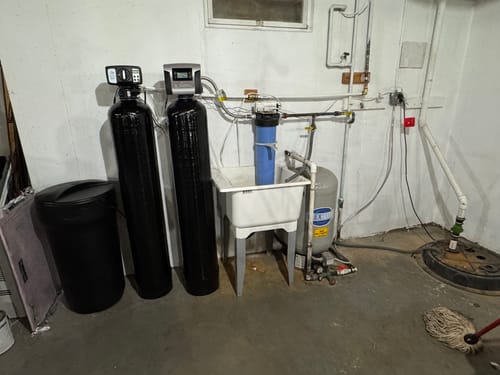
Once you know your iron levels, the next question is whether a cartridge filter can actually handle what's in your water — and that comes down to understanding what these systems do well and where they fall short.
Cartridge filters handle sediment, chlorine, and some VOCs reliably. For light contamination, they're compact, water-efficient, and straightforward to maintain — no backwashing, no wasted water.
But here's where they struggle: high concentrations of iron, manganese, or hydrogen sulfide overwhelm them. These contaminants demand specialized media that backwash systems deliver far more effectively.
Think of cartridge filters as precision tools — excellent within their range, but limited outside it. Knowing that boundary helps you make the right call before you invest in a system that can't keep up.
Why Iron Scaling Eventually Defeats a Cartridge System
Iron doesn't just pass through a cartridge filter — it builds up inside it, and that accumulation is what eventually brings the whole system to its knees. Unlike backwashable systems, cartridge filters can't flush themselves clean. There's no regeneration cycle, no way to dislodge what's collected. So iron particles keep stacking up, layer by layer, until the pressure drops, flow rates suffer, and filtration efficiency collapses entirely.
Here's what makes this especially costly: you'll replace those cartridges every 6-12 months just to keep things functional. A backwashable tank-style system, by contrast, periodically purges trapped contaminants and keeps performing for 5-10 years. The cartridge isn't failing because it's poorly designed — it's failing because iron scaling is a problem it was never built to survive long-term.
How Backwashable Iron Filters Eliminate the Problem Automatically
Backwashable iron filters solve the accumulation problem by doing something cartridge systems simply can't — they clean themselves. By reversing water flow, they dislodge trapped iron particles from the media bed before buildup compromises performance.
Backwashable iron filters do what cartridge systems can't — they clean themselves, reversing flow to flush buildup before it becomes a problem.
Scheduled backwashing cycles every 4-14 days for 10-20 minutes, flushing accumulated iron without your intervention.
Pressure monitoring detects early warning signs of media stress, letting you act before water quality drops.
Proper hydraulic agitation during backwashing prevents channeling and extends media life up to 5 years.
The result? Specialized media like Katalox-Light maintains consistent contaminant removal without constant replacement costs. You're not managing a consumable — you're operating a self-sustaining system designed for long-term performance.
Which Iron Filter Matches Your Iron Level and Household Demand
Choosing the right iron filter comes down to two things: how much iron is in your water and how much water your household uses. If your water tests at up to 20 ppm iron and 10 ppm manganese, a 1.0 cu ft stubby system handles it cleanly.
Push those numbers higher—up to 30 ppm iron, 15 ppm manganese, and 10 ppm hydrogen sulfide—and you'll want a 1.5 to 2.5 cu ft system. Household draw and your well pump's backwash flow rate determine which size within that range makes sense. If you're unsure of your pump's flow rate, call for sizing assistance before purchasing.
We also recommend Katalox-Light media—it outperforms Filox, Greensand, and Birm, lasts 6–10 years, and works at pH 6.0 or higher.
Frequently Asked Questions
How Often Should an Iron Filter Backwash?
We recommend backwashing your iron filter every 4-14 days, running it for 10-20 minutes. Your water usage and iron levels determine the exact frequency—dialing this in keeps pressure strong and water tasting clean.
Do I Need to Backwash My Pool if I Have a Cartridge Filter?
No, you don't need to backwash a cartridge pool filter! Instead, we simply remove and rinse the cartridge periodically. It's a low-maintenance approach that saves water while keeping your pool crystal clear.
What Is the Best Iron Filter for an Irrigation System?
If your irrigation system's iron levels exceed 10 ppm, we recommend a backwashable iron filter—it'll protect your sprinklers and emitters from clogging while maintaining consistent pressure and flow. Lower levels? A cartridge filter works perfectly.
Do I Need a Water Softener if I Have an Iron Filter?
You don't always need a water softener if you've got an iron filter. It depends on your water test results—if you're dealing with high hardness levels alongside iron, pairing both systems delivers superior whole-house protection.


