


![SoftPro™ Chlorine+ Carbon Whole House Water Filter to Remove PFAS, Chlorine, Chloramine & Pesticides [City Water Filters Series]](http://softprowatersystems.com/cdn/shop/files/SoftPro_Whole_House_Carbon_Filter_with_Spin_Down_Water_Filter.webp?v=1783547361&width=140)


 855-683-8488


When Ozone Is a Better Choice Than Air Injection for Iron Removal

When iron levels hit 7 ppm or higher, air injection simply can't keep up. If you're also dealing with a stubborn rotten egg smell, manganese, or slimy iron bacteria buildup, ozone is the clear winner. It oxidizes contaminants faster, handles multiple problems at once, and even suppresses bacterial growth inside the system. Air injection has its place, but for serious iron problems, ozone is the only treatment that truly delivers — and there's a lot more to this story.
Key Takeaways
- Ozone is the better choice when iron concentration reaches 7 ppm or higher, exceeding air injection's effective treatment range.
- Persistent rotten egg sulfur odors signal a need for ozone, as air injection cannot fully eliminate hydrogen sulfide.
- Ozone simultaneously oxidizes iron, manganese, and sulfur instantly, while air injection handles these contaminants inconsistently.
- Recurring iron bacteria slime indicates ozone is needed, since it actively suppresses bacterial growth unlike air injection.
- Despite higher upfront costs, ozone eliminates chemical additives and reduces maintenance, making it more economical long-term.
Why Air Injection Falls Short With Heavy Iron and Sulfur

Air injection filters work well for mild iron problems, but they hit a wall when iron or manganese concentrations climb above 7 ppm. At that point, the oxidation simply isn't fast or powerful enough to keep up. You'll notice it in the staining, the lingering metallic taste, and especially that rotten egg sulfur smell that air injection can't fully knock out.
Manganese is particularly stubborn. Air filters struggle to oxidize it consistently, and the result is breakthrough contamination that no amount of filter maintenance will fix. Worse, if you're seeing recurring iron bacteria slime, air injection offers zero sanitizing capability—it just can't eliminate biological buildup. These are the conditions where air injection stops being a solution and starts being a liability.
When Should You Choose Ozone Over Air Injection?
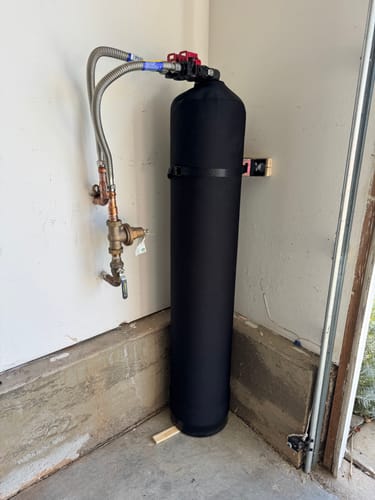
Four conditions tell us it's time to step up from air injection to ozone: heavy iron at 7 ppm or higher, a strong rotten-egg sulfur odor that won't quit, manganese in the mix, or recurring iron bacteria slime. If you're staring down any one of these, air injection simply won't keep pace.
Here's why ozone prevails in these scenarios: it oxidizes iron, manganese, and sulfur faster than plain air, and it continuously disinfects the filter tank, stopping bacteria before they reestablish. No chlorine, no consumables, no ongoing chemical costs.
Before you commit, get a certified lab test confirming your iron, manganese, sulfur, pH, and bacteria levels. That data removes the guesswork and verifies you're sizing the right system for what's actually in your water.
What Makes Ozone a Stronger Oxidizer for Iron Removal
Ozone earns its reputation as a heavy hitter because of what it actually is at the molecular level: three oxygen atoms bonded together in an unstable configuration that's itching to react. That instability is exactly what makes it so effective.
When ozone contacts dissolved ferrous iron, it doesn't negotiate — it oxidizes it almost instantly, converting Fe2+ into insoluble Fe3+ particles your filter can actually trap. Air injection simply can't match that speed or aggression. Ozone also tackles manganese and hydrogen sulfide simultaneously, and it suppresses iron bacteria growth that would otherwise clog your filter over time.
Better still, we generate it on-site, on demand — no chemical tanks, no pre-treatment hassle. It's a cleaner, faster, and more complete oxidation solution.
How an Ozone Iron Filter System Works
When you run water through one of our ozone iron filter systems, a tightly coordinated process kicks in that handles everything from oxidation to sanitation without any chemicals or manual intervention.
Ozone generates on-site and injects into the filter tank's air pocket, instantly oxidizing dissolved iron, manganese, and hydrogen sulfide.
Ozone generates on-site, instantly oxidizing dissolved iron, manganese, and hydrogen sulfide the moment water enters the system.
The filter media captures those oxidized metals as water passes through.
A nightly backwash cycle flushes the trapped contaminants directly to drain.
Ozone continuously sanitizes the media bed, eliminating iron and sulfur bacteria before they cause problems.
The system's sealed, consumable-free design means we're not chasing chemical dosages or worrying about residuals—ozone simply breaks down into oxygen and disappears.
Ozone Iron Filter Cost, Maintenance, and Long-Term Savings
While ozone iron filter systems carry a higher upfront cost than traditional air injection filters, they more than make up for it over time. Without chemical additives, salt, or consumables eating into your budget, the savings accumulate quickly.
Ozone's disinfecting power also suppresses iron bacteria growth, which means your filter media lasts longer and needs replacing far less often.
Maintenance stays minimal, too. The integrated ozone generator handles oxidation on demand — no manual intervention, no babysitting. You'll want to keep the generator itself properly serviced, but compared to alternative filtration methods, the hands-on workload is considerably lighter.
When you factor in reduced media replacements, eliminated consumable costs, and consistent automated performance, the long-term value of an ozone system becomes impossible to ignore.
Frequently Asked Questions
What Is the Success Rate of Ozone Injection?
We've seen ozone treatment achieve a 98% success rate in eliminating hydrogen sulfide and controlling bacterial growth. It's a powerhouse solution that consistently outperforms traditional methods when you're tackling stubborn water quality issues.
What Is the Best Water Filter for Removing Iron From Well Water?
For high-iron well water, we'd recommend an ozone-based iron filter. It's chemical-free, handles 7+ ppm, eliminates iron bacteria, and continuously sanitizes the media—delivering superior, low-maintenance performance over standard air injection systems.
What Are the Disadvantages of Ozone Disinfection?
Ozone disinfection's disadvantages include harmful byproducts like bromate, shorter contact times, expensive equipment, complex safety requirements, and sensitivity to water quality factors like pH and temperature — all demanding careful monitoring and system optimization from us.
How Long Should I Air Out My House After Using an Ozone Machine?
We recommend you air out your house for 1-2 hours after using an ozone machine. Open your windows and doors to guarantee proper ventilation, allowing remaining ozone to fully dissipate before re-entering.


