


![SoftPro™ Chlorine+ Carbon Whole House Water Filter to Remove PFAS, Chlorine, Chloramine & Pesticides [City Water Filters Series]](http://softprowatersystems.com/cdn/shop/files/SoftPro_Whole_House_Carbon_Filter_with_Spin_Down_Water_Filter.webp?v=1783547361&width=140)


 855-683-8488


Why Chemical-Free Iron Filtration Is Preferred for Most Residential Wells

Chemical-free iron filtration is preferred for most residential wells because typical well water iron levels fall well within what air injection systems can handle. Most wells test below 15 ppm iron, which means you don't need harsh chemicals to get clean water. Air injection oxidizes dissolved iron into filterable particles, and catalytic media captures them efficiently. It's simpler, safer, and more cost-effective long-term — and there's a lot more to understand about why this approach works so well.
Key Takeaways
- Most residential wells have iron levels below 15 ppm, well within the chemical-free filtration effective range of up to 30 ppm.
- Air injection systems convert dissolved iron into solid particles without chemicals, using only controlled oxidation and mechanical filtration.
- Katalox Light media lasts 6–10 years, reducing maintenance needs compared to chemical treatment systems requiring ongoing additive purchases.
- Chemical-free systems carry higher upfront costs but deliver lower total expenses over a 10-year period than chemical alternatives.
- No chemicals or additives means fewer safety concerns, simpler operation, and reduced risk of chemical mishandling for homeowners.
Why Most Wells Don't Need Chemicals to Remove Iron

Most residential wells have iron levels below 15 ppm — and that's actually good news, because it means you likely don't need harsh chemicals to fix your water.
Air injection oxidation systems work by converting dissolved ferrous iron into filterable ferric iron, purely through oxygen exposure. No chlorine. No salt. No ongoing chemical costs. The dissolved iron fundamentally/inherently oxidizes and becomes a solid particle that a quality filter media can capture.
We've seen this approach work reliably across a wide range of well water conditions, even at lower pH levels. When your iron problem falls within that common range, a chemical-free system isn't just a preference — it's the smarter, simpler solution that saves you money and keeps your water clean without the complications.
How Chemical-Free Air Injection Actually Works
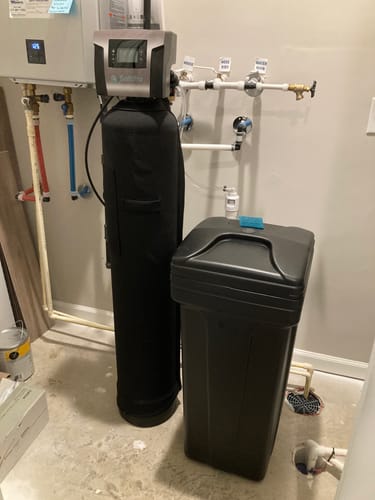
There are really just 3 things happening inside one of these systems — and once you understand them, the whole process makes perfect sense.
First, the Fleck 2510AIO valve automatically injects air into the treatment tank. That air creates an oxidation environment that converts dissolved ferrous iron — the invisible, water-soluble kind — into ferric iron, the solid, filterable kind.
Air in, iron out. The Fleck 2510AIO valve oxidizes dissolved iron into solid particles — no chemicals required.
Second, those newly formed particles get trapped by the Katalox Light media packed inside the tank. It's a highly reactive filtration bed that also captures manganese and hydrogen sulfide.
Third, the system backwashes itself, flushing out the captured contaminants.
No chemicals. No additives. Just controlled oxidation and mechanical filtration working together. That's how you remove up to 30 ppm of iron without touching a single chemical bottle.
What Chemical-Free Iron Filtration Can and Can't Remove
Now that you know how the system works, let's be straight about what it can and can't handle.
Katalox-Light handles iron up to 30 ppm, manganese up to 15 ppm, and hydrogen sulfide up to 10 ppm — without chemicals or salt. That covers the most common residential well water complaints, and it does so reliably.
But here's where we've to be honest: if your water also carries bacteria, tannins, or hardness, chemical-free iron filtration won't solve those problems alone. It's not designed to.
The smart move is testing your water fully before choosing a single-system solution. Iron filtration excels at what it's built for. Pair it with the right additional treatment, and you've got a complete system that actually works.
Chemical-Free Iron Filtration vs. Chemical Treatment: 10-Year Cost
When people compare iron filtration options, they typically focus on the upfront price — and that's exactly where chemical-free systems appear to lose. But zoom out to 10 years, and the story flips entirely.
Chemical treatment systems bleed money through recurring chemical replenishment. Chemical-free systems using Katalox-Light media? Minimal maintenance — just periodic backwashing and occasional media replacement.
| Cost Factor | Chemical-Free System | Chemical Treatment System |
|---|---|---|
| Upfront Cost | Higher | Lower |
| Recurring Chemical Costs | None | Significant |
| Maintenance Requirements | Minimal | Ongoing |
| 10-Year Total Cost | Lower | Higher |
Katalox-Light media lasts 6–10 years, outperforming Filox, Greensand, and Birm. That durability compounds the savings. We've seen it consistently — higher upfront investment, but the long-term economics are undeniable.
When Chemical-Free Filtration Falls Short and What to Use Instead
Chemical-free filtration is a powerful solution — but it's not a universal one. Some conditions simply exceed its capabilities, and recognizing those limits protects your investment.
Chemical-free filtration is powerful — but knowing its limits is just as important as knowing its strengths.
When iron climbs above 15 ppm, you'll likely need a high-capacity iron filter or chemical oxidation system. Above 20 ppm — or when iron bacteria become severe — shock chlorination with ongoing chemical treatment becomes necessary.
Low pH, below 6.5, weakens chemical-free performance, so we recommend adding an acid neutralizing filter.
Facing a combination of high iron, manganese, and hydrogen sulfide? A multi-stage system with chemical oxidation and specialized media is your best path forward. And if tannins exceed 10 ppm, add a dedicated tannin removal system to protect downstream components like reverse osmosis membranes.
Frequently Asked Questions
What Is the Best Home Iron Filter for Removing Iron From Well Water?
We recommend a chemical-free air-injection oxidation system using Katalox Light media. It'll remove up to 30 ppm of iron, requires no chemicals, and outperforms competing media like Filox, Greensand, and Birm.
What Is the Most Effective Filtration System for Well Water?
We recommend air-injection Katalox-Light filtration systems—they're chemical-free, remove iron, manganese, and hydrogen sulfide effectively, and outperform competing media with a 6-10 year lifespan, making them the smartest long-term investment for your well water.
What Is the Best System for Removing Iron From Well Water?
We recommend the Fleck 2510AIO air-injection valve paired with Katalox Light media in a Vortech tank—it removes up to 30 ppm iron without chemicals, lasts 6-10 years, and backwashes automatically.
What Are Common Problems With Iron Filters?
Common problems we see include greensand's costly chemical regeneration, Birm's strict pH limitations, and Filox's demanding backwash rates that overwhelm most residential pumps—all issues that Katalox-Light's chemical-free design conveniently sidesteps.


