![SoftPro™ Chlorine+ Carbon Whole House Water Filter to Remove PFAS, Chlorine, Chloramine & Pesticides [City Water Filters Series]](http://softprowatersystems.com/cdn/shop/files/SoftPro_Whole_House_Carbon_Filter_with_Spin_Down_Water_Filter.webp?v=1783547361&width=140)


 855-683-8488


Fluoride & Tap Water: 5 Surprising Truths About Your Home's Water Quality
Table of Contents
The Invisible Baseline: Why Your 7,300-Day Relationship Matters
Most of us maintain a 20-year relationship with our tap water without ever questioning its chemical composition. Over approximately 7,300 days, we drink, cook, and bathe in a resource we assume is a managed constant—a utility overseen by distant experts that we have no say over. However, as any health-conscious technologist understands, the "baseline" provided by your city isn't a fixed reality; it’s a series of community-level averages. To truly optimize your domestic environment, you must move from a passive consumer to a proactive manager of your home’s most vital resource.
The Granularity Gap: Why City Reports Aren't Personal Data
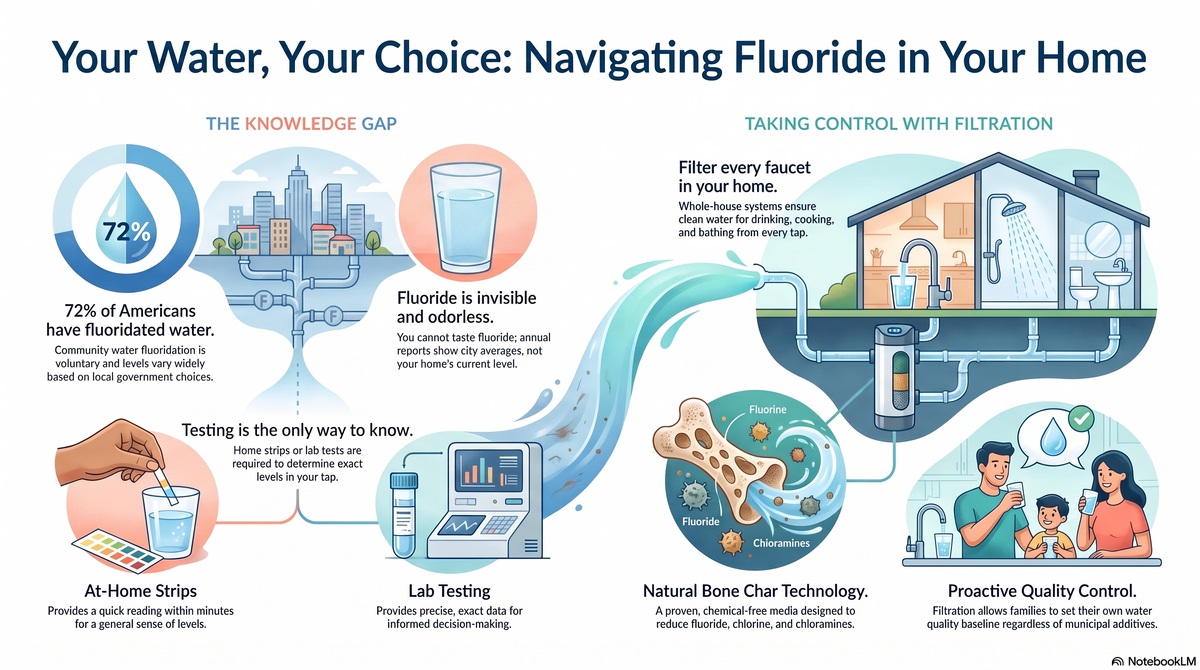
While municipalities are legally required to provide annual water quality reports, these documents are the data equivalent of a wide-angle lens. They reflect city-wide averages rather than the real-time granular data of what’s exiting your specific kitchen faucet. Because additives like fluoride are completely tasteless and odorless, it is physically impossible to detect their concentration through your senses alone.Furthermore, a utility staying within regulated thresholds does not ensure that those levels remain consistent every time you turn on the tap. As the data suggests, a municipal "recommended" level is merely a guideline, not a guarantee of consistency."Recommended is a guideline, not a guarantee of consistency."For families who prioritize precision and bio-optimization in their daily lives, relying on a broad geographic average is no longer the gold standard. Testing is the only way to move from guessing to knowing exactly what your family is consuming.
The 72% Rule: Voluntary Fluoridation and the Shift Toward Household Autonomy
Approximately 72% of Americans on public water systems receive fluoridated water. While this is standard practice, the technical reality is that water fluoridation is a voluntary local decision, not a federal mandate. This means your water profile is a reflection of a community-level choice—one that may or may not align with your specific wellness philosophy.Increasingly, discerning households are viewing water filtration not as a statement against public health, but as a lifestyle optimization similar to selecting organic produce or high-grade air purification. It is a fundamental shift from community-standardized outcomes to individual household autonomy."Your home, your water, your choice."
Beyond Compliance: Navigating the Regulatory Threshold of Personal Preference
The EPA sets maximum regulatory limits for additives, and while most utilities stay well within these legal boundaries, "within limits" is a regulatory standard, not a personal one. In some regions, naturally occurring fluoride levels in groundwater are perfectly legal but significantly higher than what a family might prefer for their long-term baseline.Choosing to filter your water isn't about fear; it’s about establishing a personalized household standard. Whether you prefer the benefits of municipal additives or want a minimal-additive profile, both choices are valid. The goal is to move from a state of "unconscious consumption" to a "proactive preference" model.
The Private Well Paradox: When "Natural" Doesn't Mean "Ideal"
For those on private wells, the situation is the "Wild West" of water quality. Well water users exist outside the purview of municipal reports and federal oversight. In these cases, fluoride can occur naturally in groundwater at high concentrations depending on local geography—often without the homeowner’s knowledge.Without routine testing, well owners are operating on assumptions rather than data. Moving from "guessing" to "knowing" is critical for those who rely on groundwater, as natural mineral levels can fluctuate and deviate from the ideal wellness profile of the home.
Bio-Optimized Filtration: The Bone Char and Catalytic Carbon Edge
If you decide to take control of your water quality, the technology used matters. Many consumers are familiar with Reverse Osmosis (RO), but for the wellness-focused individual, RO has its drawbacks—it is often wasteful, discharging significant amounts of water, and can leave you with "overprocessed" water that has been stripped of beneficial minerals.A more sophisticated, natural alternative is the dual-media approach utilized by SoftPro. By combining Bone Char and catalytic carbon , a whole-house system targets fluoride, chlorine, and chloramines without the use of complex chemicals or wasteful processing.
-
Mineral Preservation: Unlike RO, this technology reduces additives while preserving the water’s natural mineral balance.
-
Every-Tap Consistency: By installing a whole-house solution, you establish a clean baseline for drinking, cooking, and even the water you absorb through your skin while bathing.
-
Technological Efficiency: This is a proactive, low-maintenance investment in the domestic ecosystem, ensuring that the water at every faucet meets your specific household standards.
The Long-Term Baseline: Engineering Your Domestic Ecosystem
Managing your home's water quality is no longer a complex or out-of-reach endeavor; it is an accessible lifestyle upgrade. As you consider the next 7,300 days of water consumption in your home, ask yourself: what do you want your baseline to look like?The first step toward informed choice is data. To move beyond the averages and see exactly what is happening in your pipes, seek out a personalized "Water Score" from SoftPro. Once you have the data, you can stop guessing and start engineering the water quality your family deserves.