


![SoftPro™ Chlorine+ Carbon Whole House Water Filter to Remove PFAS, Chlorine, Chloramine & Pesticides [City Water Filters Series]](http://softprowatersystems.com/cdn/shop/files/SoftPro_Whole_House_Carbon_Filter_with_Spin_Down_Water_Filter.webp?v=1783547361&width=140)


 855-683-8488


Gresham's Water Just Changed Forever: Why Your Skin, Hair, & Pipes Are Paying the Price & How SoftPro Is Helping Homeowners Fix It
Gresham's Water Just Changed Forever: Why Your Skin, Hair, & Pipes Are Paying the Price & How SoftPro Is Helping Homeowners Fix It
Gresham Oregon hard water is a new problem for most homeowners: the city's Water Bureau is shifting part of its supply from soft Bull Run surface water to mineral-rich groundwater, pushing household hard water levels from under 1 grain per gallon toward the 3.4–8+ grain "moderately hard to hard" range.

Last updated: September 2026
Key Takeaways
- Gresham's Water Bureau is blending in supply from the Cascade Groundwater Alliance's Sand and Gravel Aquifer wells, moving away from a full reliance on Bull Run surface water.
- The City of Gresham's own lists Cascade groundwater hardness at 58–108 mg/L — about 3.4–6.3 grains per gallon (GPG), classified as "moderately hard."
- SoftPro's own field testing in Gresham neighborhoods already receiving blended supply has recorded readings as high as 8.2 GPG, in the "hard" classification per the Water Quality Association's scale.
- The switch traces to cost: Portland's EPA-mandated Bull Run filtration plant is projected at $850 million–$1.2 billion, per the
- Gresham's new wells, like the one at Kirk Park, reach roughly 600 feet into the Sand and Gravel Aquifer and can pump 4 million gallons a day, according to Portland Tribune/KOIN reporting.
- Standard carbon or sediment filters cannot remove hardness because calcium and magnesium are dissolved, not suspended — only ion exchange physically removes them, per NDSU Extension.
- More than 85% of U.S. households already deal with some degree of hard water, according to the Water Quality Association.
What Changed in Gresham, Oregon's Water Supply?
For decades, Gresham bought nearly all of its water from Portland's Bull Run Watershed, a protected, unfiltered surface-water source in the Mount Hood National Forest that receives about 135 inches of precipitation a year and stores close to 10 billion gallons across two reservoirs, according to the City of Gresham's 2026 Water Quality Report. That surface water is naturally very soft — light on dissolved minerals because it never spends much time moving through rock.
Gresham is now developing its own groundwater system through the Cascade Groundwater Alliance, pumping from the Sand and Gravel Aquifer roughly 600–1,200 feet underground. A pilot well at Kirk Park already pumps about 4 million gallons a day, with more wells planned to build out a full local groundwater system, reported Portland Tribune/KOIN. Unlike soft Bull Run water, groundwater travels through rock and soil on its way to the aquifer, picking up dissolved calcium and magnesium — the minerals that define water hardness.
Why Did Gresham Switch From Bull Run to Groundwater?
The short answer is cost. Portland's Bull Run supply is unfiltered, and the EPA now requires filtration to guard against Cryptosporidium — a project the Cascade Groundwater Alliance estimates at $850 million to $1.2 billion, with the bill split across every customer city, including Gresham. Gresham's own groundwater, by contrast, is already treated to meet state and federal standards and needs no new filtration plant, so the city projects smaller rate increases by leaning on it instead.
Groundwater carries a second advantage city officials have cited: resilience. The Sand and Gravel Aquifer sits underground and is less exposed to earthquakes and wildfire than a surface reservoir fed by mountain runoff, which is part of why Gresham's council approved its Groundwater Master Plan after years of study, per the Cascade Groundwater Alliance page. What officials frame as a resilience and cost win, though, shows up in homes as a sudden hardness increase nobody budgeted for.

SoftPro™ Fluoride & Chlorine+ SUPER Filter (Whole House Catalytic + Bone Char Carbon Filter)
VIEW NOW
SoftPro™ AIO Iron Master - Best Iron Filter for Well Water (Air Injected Water Filter / Katalox)
VIEW NOW![SoftPro™ Chlorine+ Carbon Whole House Water Filter to Remove PFAS, Chlorine, Chloramine & Pesticides [City Water Filters Series]](https://cdn.shopify.com/s/files/1/2723/7368/files/SoftPro_Whole_House_Carbon_Filter_with_Spin_Down_Water_Filter.webp?v=1783547361)
SoftPro™ Chlorine+ Carbon Whole House Water Filter to Remove PFAS, Chlorine, Chloramine & Pesticides [City Water Filters Series]
VIEW NOW
![SoftPro™ pH Neutralizer Calcite Filter for Neutralizing Acidic Water [WELL WATER]](https://cdn.shopify.com/s/files/1/2723/7368/files/pH_Neutralizer_Calcite_Filter.webp?v=1785376051)
How Hard Is Gresham's New Groundwater, Exactly?
The City of Gresham's own numbers put Cascade groundwater hardness at 58–108 mg/L, which converts to roughly 3.4–6.3 grains per gallon (GPG) — the Water Quality Association classifies that range as "moderately hard." SoftPro's own on-site water tests across Gresham households already receiving blended city supply have measured hardness running higher in some neighborhoods, up to 8.2 GPG, which crosses into the WQA's "hard" tier. The gap between the two figures is typical of a supply in transition: the blend ratio of Bull Run to groundwater varies by pressure zone and season, so two homes a few streets apart can test differently right now.
Hardness range from Bull Run surface water to Gresham's transitioning groundwater blend, based on City of Gresham water-quality data and SoftPro field testing.
Why Don't Regular Water Filters Fix Hard Water?
Most consumer filters — pitcher filters, fridge filters, basic under-sink cartridges — are built to trap particles and reduce chlorine taste or odor. Calcium and magnesium don't behave like particles; they're fully dissolved in the water itself, so they pass straight through activated carbon or sediment media untouched. That's why a homeowner can install a filter, see no change in soap scum or dry skin, and assume nothing is wrong with the water — when the real issue was never something a filter targets in the first place.
How Does Ion Exchange Remove Water Hardness?
Ion exchange is the accepted method for removing dissolved hardness minerals, according to NDSU Extension. A softener passes water through a resin bed coated in sodium (or potassium) ions. Because calcium and magnesium ions carry a stronger charge, they displace the sodium on the resin and stay behind, while softened water — now carrying sodium instead of hardness minerals — continues to the tap. Once the resin is saturated, the system backwashes with a brine solution to recharge it and flush the captured minerals away.
| Treatment type | What it targets | Removes hardness? |
|---|---|---|
| Sediment / carbon pitcher filter | Suspended particles, chlorine taste/odor | No — minerals are dissolved, not filtered |
| Reverse osmosis (point-of-use) | Dissolved solids at one tap | Partially — only at that fixture, not whole-home |
| Ion exchange water softener | Dissolved calcium & magnesium, whole-home | Yes — resin swaps hardness ions for sodium/potassium |
What Does Softer Water Change Day-to-Day for Gresham Homeowners?
Households that install a whole-home ion exchange system typically notice the difference within days rather than weeks. Soap and shampoo rinse clean instead of leaving a filmy residue on skin and hair. Fewer scale deposits build up inside pipes, water heaters, and appliances over time, which protects fixture lifespan. For households where skin sensitivity or digestive concerns became more noticeable alongside the water change, removing hardness minerals from every tap addresses one variable that had been working against them at every shower and load of laundry.
SoftPro™ Fluoride & Chlorine+ SUPER Filter (Whole House Catalytic + Bone Char Carbon Filter)
VIEW NOW
SoftPro™ AIO Iron Master - Best Iron Filter for Well Water (Air Injected Water Filter / Katalox)
VIEW NOW
SoftPro™ Chlorine+ Carbon Whole House Water Filter to Remove PFAS, Chlorine, Chloramine & Pesticides [City Water Filters Series]
VIEW NOWWhat Should Gresham Homeowners Do About the Water Change?
Because Gresham's supply shift is a citywide infrastructure decision, individual households have no control over when or whether the blend ratio changes again. A whole-home ion exchange softener sidesteps that uncertainty by treating water at the point it enters the house, so every fixture — kitchen, shower, laundry, water heater — gets the same treatment regardless of what the city sends down the pipe that week. SoftPro Water Systems works directly with Gresham homeowners to size a system around current local conditions rather than guessing at hardness levels, and has already installed systems in hundreds of Gresham households adjusting to the new supply.
For homeowners who want to see exactly where their own water falls on the hardness scale before deciding on a system, SoftPro's Gresham water guide breaks down local hardness data and recommended grain capacities, and the GPG comparison guide explains how to read a hardness test result once you have one.
How Gresham's supply switch translates into home-level symptoms, and where ion exchange breaks the chain.

Get Your Water Tested Before You Guess at a System
SoftPro's free Water Analysis Report shows exactly where your Gresham home falls on the hardness scale so you can size a system around real numbers, not a citywide average.
Get Your Free Water Analysis ReportFrequently Asked Questions
Why did Gresham, Oregon's water suddenly get harder?
Gresham's Water Bureau is shifting part of the city's supply from soft Bull Run surface water to groundwater drawn from the Sand and Gravel Aquifer through the Cascade Groundwater Alliance. Groundwater naturally picks up more calcium and magnesium as it moves through rock and soil, which raises overall hardness.
What are the symptoms of a sudden water hardness increase?
Homeowners commonly report dry or itchy skin, increased hair shedding, soap and shampoo that won't fully rinse off, a lingering chlorine smell, scale buildup on fixtures and appliances, and in some cases digestive or gut sensitivity that worsens.
Will a regular water filter fix hard water?
No. Most standard water filters trap particles like sediment or reduce chlorine taste and odor. They are not built to remove dissolved hardness minerals such as calcium and magnesium, so hardness passes straight through untouched.
What actually removes water hardness?
Ion exchange is the standard, proven method. A resin bed swaps calcium and magnesium ions for sodium or potassium ions as water flows through, physically removing hardness rather than masking it.
How hard is Gresham's new groundwater, in grains per gallon?
The City of Gresham lists Cascade groundwater at 58–108 mg/L, or roughly 3.4–6.3 GPG, classified as moderately hard. SoftPro's field readings in some Gresham homes on blended supply have measured higher, up to 8.2 GPG, in the hard range.
Do I need to wait for the city to fix this?
No. A whole-home ion exchange system installs directly in your house and treats every tap on your own timeline, independent of any citywide infrastructure decision.
Where can Gresham homeowners get a whole-home water softening system?
SoftPro Water Systems works directly with Gresham homeowners to assess local water conditions and recommend the right system size and setup for each home. More information is available at softprowatersystems.com.
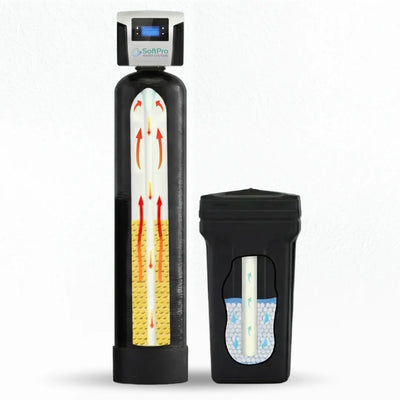
SoftPro™ Elite Smart HE - Best Water Softener for City Water
$1,367.00 $2,468.65 Sale
Sources: City of Gresham Water Quality, Cascade Groundwater Alliance, 2026 Gresham Water Quality Report, Portland Tribune/KOIN, KATU News, NDSU Extension, Water Quality Association hardness scale, University of Florida IFAS Extension.


